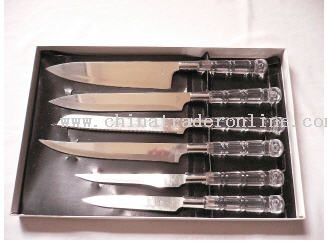
Peeling Knife
A peeling knife sits in the kitchenware aisle as the smallest, most task-specific member of the knife family. Shoppers browsing this shelf usually already own a chef knife and a paring blade, and they arrive looking for a short, curved, pointed tool built for trimming, coring and lifting skins away from produce. The category listing reflects that focus: one direct product, staying firmly within a mid range price band.
Kitchen knives of every length surround this entry, from long slicers to compact utility knives, and the peeling knife earns its place by doing what larger blades cannot. A narrow, slightly curved edge lets the cook follow the contour of an apple or a potato, while the fine tip reaches into eyes and stems. Neighboring shelves hold knife sets, which is the usual route for buyers assembling a full block.
Elsewhere on the same aisle sit ceramic knives, steak knives, stainless steel knives and multifunctional knives, each with a distinct job. The peeling knife overlaps most closely with utility knives, yet its shorter profile suits hand-held work over a cutting board. Buyers comparing the shelf often pair it with a paring knife rather than choosing between the two.
Materials and construction guide most decisions at this price band. Shoppers examine blade steel, handle grip and the balance point between fingers, since a peeling knife is controlled by the hand rather than pressed down. Stainless steel options dominate nearby listings, and many buyers favor a smooth handle that stays secure when produce is wet.
Merchandising this category works best as a compact, focused presentation. Group the peeling knife with kitchen knives and knife sets so buyers see it as part of a complete collection rather than an isolated specialty tool. Clear imagery showing the curved blade and pointed tip answers the main question shoppers bring to this shelf.
1 products