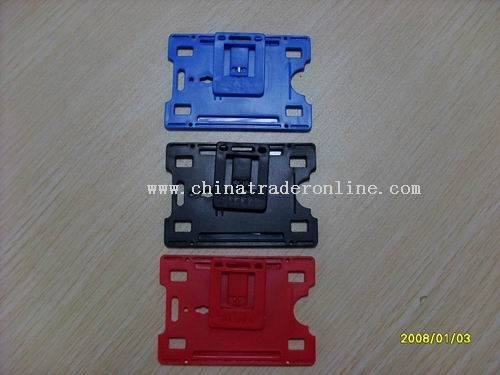
Badge Holders and Lanyards: 5 Attachment Specs
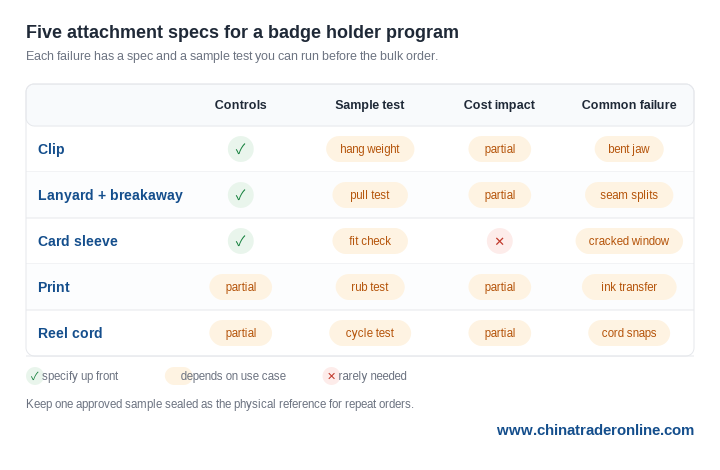
Badge holders and lanyards are specified as one item and fail as five. The clip bends, the lanyard seam gives way, the card sleeve cracks, the print rubs off, or the safety breakaway never releases when it should. If you are ordering for an event, a campus or a workforce, the five attachment specs below are the ones to lock before you place the order. Each has a number or a test you can check on a sample, which is what turns a catalogue choice into a defensible purchase.
Clip Type and Its Load Limit
The clip decides how the badge is carried day to day. A simple swivel hook is cheap and fast to clip on, but it can twist and wear a hole in fabric. A bulldog or crocodile clip grips a pocket or belt firmly and suits uniforms; a retractable reel keeps the card accessible without unclipping and is the common choice for offices and trade shows. Each has a different failure mode, so pick by how the badge will actually be worn.
Specify a minimum load the clip must hold without deforming, and say how it is tested: hang a weight from the clip for a set time and inspect for bending or a sprung jaw. A clip that holds a card in the packaging but fails after a week on a lanyard is the most common complaint in this category, and it is entirely avoidable with a sample test.
Lanyard Strength and Breakaway Behaviour
A lanyard carries a light load, but it must survive being caught, pulled and twisted repeatedly. Two specs matter: the tensile strength of the strap and its stitching, and the release force of a safety breakaway clasp. The breakaway exists so a snag does not pull a badge around the neck of the wearer, so it must release at a defined force, not too easily and not too stubbornly. If the badge will be worn around machinery or by children, a breakaway clasp is not optional.
Ask the supplier for the strap width, material and the stitch pattern at the attachment point, then test a few samples by pulling firmly and checking that the seam holds while the breakaway releases at roughly the intended force. A clasp that never releases defeats its purpose; one that opens when the badge bumps a desk loses cards all day.

Card Sleeve Thickness and Fit
The sleeve protects the card, and its thickness and internal dimensions decide whether it does that job. Too thin and the window flexes and scratches the card face; too tight and the card is hard to insert or bulges at the corners. Specify the outer material, a nominal thickness, and the internal size matched to your card, allowing a small clearance so a printed or laminated card still slides in.
Also check the window itself. A clear PVC window should resist scratching and stay legible under office lighting; a cloudy or easily scuffed window defeats the point of an ID badge. Hold a sample up to a light source and look for distortion, and rub the window with a soft cloth to see if it marks easily.
Print Method and Rub Resistance
Lanyard printing is usually silkscreen, dye sublimation or woven. Silkscreen is economical for simple logos and few colours; dye sublimation gives a smooth full-colour finish on polyester; woven labels are durable but limit fine detail. Choose by the logo, not by the lowest price, and specify the number of colours and the print position on the strap.
Ask for a rub test on a printed sample: rub the logo a set number of times with a dry and then a slightly damp cloth and check for transfer or fading. A logo that looks sharp in the photo but lifts after a dozen rubs will not survive a week of wearing, and it is the detail most visible to the recipient.
Putting the Five Specs in One Sheet
Write all five as lines a supplier can quote against: clip type and minimum load, lanyard width and breakaway release, sleeve material and internal size, print method and colour count, and the rub and pull tests with pass criteria. Attach a photo of an approved sample and keep one sealed as the physical reference. When a factory changes a clasp supplier or a strap material, repeat the same tests before the new batch ships.
None of this is complicated, but all of it is easy to skip on a small, low-cost item. Specifying the five attachment points is what separates a badge program that lasts a season from one that needs re-ordering after a month. For help matching a holder and lanyard to your badge size and branding, browse our badge holder range and send us your card dimensions and quantity.
Sourcing products from China?
Send your product list and target quantity for a quote and a digital proof.
Get a free quote