Desk Clocks for Corporate Gifts: 6 Mechanism Options
A desk clock is judged on two things long after the unboxing: can the recipient set it in under a minute, and does it tick loudly enough to annoy them at their desk. Both come from the mechanism, not the case. If you are sourcing clocks for a corporate gift programme, here are six mechanism options and the buyers each one suits, so you can match the movement to the recipient rather than picking the prettiest housing.
1. Quartz sweep (silent)
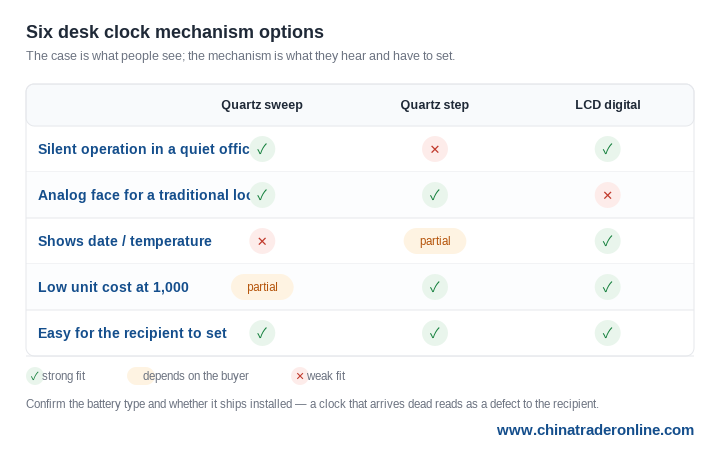
A sweep movement drives the second hand smoothly and runs without an audible tick. It is the safest choice for an office gift, where a loud tick on a quiet desk is a real irritation. Sweep quartz costs a little more than a step movement but reads as a quality product, and it works well across analog case styles from metal to wood. For a broad corporate list where you do not know the recipient, this is the default pick.
2. Quartz step (tick)
The step movement advances the second hand once a second with a visible tick. It is the cheapest analog option and perfectly acceptable in a busy reception or workshop where the tick is lost in background noise. It is not the right choice for a quiet open-plan office or a bedside setting. If cost is the driver and the environment is noisy, step quartz delivers an analog face at a lower unit price.
3. LCD digital
A digital movement can show time, date, day and temperature on one small display, which makes it useful for a practical gift. It is inexpensive and easy to read at a glance, but it has no analog face, so it does not suit a traditional or premium look. Confirm the display language and the date format for your market — a US month/day layout will confuse a European recipient — and check that the backlight, if present, is not so bright it is distracting at night.
4. Temperature and humidity displays
Some movements add a thermometer or hygrometer to the face. These are a nice touch for a home or reception gift and cost little extra, but the sensors are approximate rather than calibrated instruments. Do not position them as measurement devices in the product copy; treat them as a convenience feature. If accuracy matters to the buyer, leave this option out of the quote.
5. Novelty and themed movements
For event gifts, a themed or shaped clock — a novelty housing, a branded silhouette — can carry more personality than a standard round face. These usually use a basic step or sweep movement inside a custom mould. Confirm that the movement is still accessible for battery changes and that the theme does not date the gift. Novelty works for a one-off event; for an annual programme, a clean standard face with your logo is easier to repeat.

6. Wood and metal case movements
The case material does not change the mechanism, but it changes what the movement has to work around. Wood cases dampen sound and suit a sweep movement; thin metal cases can amplify a tick, so pair them with a silent movement for an office gift. Check the battery access on the finished clock — a beautiful case with a battery door buried at the back and no clear opening is a small but persistent complaint.
Battery, compliance and what ships in the box
Most desk clocks run on a single AA or AAA cell, and the choice of whether that battery ships installed is worth deciding explicitly. Installed batteries are convenient for the recipient but add weight and can trigger transport rules for certain cell types; loose batteries avoid that but mean the clock does not work until the recipient finds a coin and opens the door. For a gift, an installed battery with an insulating tab pulled at unboxing is the cleanest compromise — ask whether the factory can do it. Confirm the battery type is readily available in your market; an odd cell size turns a gift into a chore.
On compliance, check what the market requires for the clock as a finished product. Battery-powered clocks are usually low-risk, but a clock with an adapter, a backlight or a radio-controlled movement may fall under additional electrical or radio rules. Ask for the relevant declarations rather than assuming a generic CE mark covers every variant, and keep the documents on file for the gift programme's records. These details are invisible when the clock works and very visible when a shipment is held at customs.
Specifying the clock for a gift programme
Put the movement type on the purchase order along with the battery type and whether a battery ships installed. A clock that arrives dead reads as a defect to the recipient, even when the battery is simply in a separate bag. Ask for a setting instruction card in the box, and confirm the logo method on the actual case material. Keep one approved sample with the exact movement so later batches can be compared on the tick test, not just the look.
To compare cases and movements, review our desk clock range, then request a free sample and quote with your recipient profile and market. We will send a sample you can set and listen to before the run.
Sourcing products from China?
Send your product list and target quantity for a quote and a digital proof.
Get a free quote


