Sports and Outdoor Sourcing: 4 Sub-categories to Test First
A general catalogue can show you thousands of sports and outdoor products and still leave you with no idea what to order first. The ones that look exciting on a screen - vehicles, complex apparel, anything with a motor - are often the worst place to start because returns, sizing and compliance stack up before you have learned the supplier. A better opening move is to screen sub-categories by how likely they are to come back and how clearly they can be specified, then test a small set. This guide sets out that screen and names four sub-categories that suit a first order, with the checks to run before you place one. The goal is not the biggest catalogue; it is a first shipment that sells without a claim attached.
1. Screen by Return Risk, Not Catalogue Size
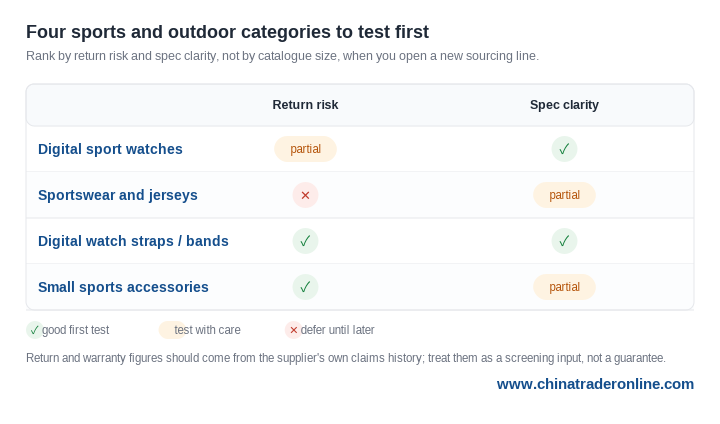
Return risk is the cost that quietly destroys a first order. A product with ambiguous sizing, a fit that varies by body type, or a function a buyer cannot verify from a photo will come back at a rate that erases the margin. Ask each supplier for their own return and defect history on the exact SKU, not a category average. Treat the answer as a screen rather than a promise: a supplier who cannot discuss returns at all is telling you something. Weight the answer by unit price and by who pays the return freight. A low-cost item with a modest return rate is often safer than a premium item with the same rate, because the absolute loss is smaller. Write down the top three return causes you hear and check whether a clear spec could have prevented each one.
2. Spec Clarity: Can You Write It Down?
The second filter is whether the product can be described in a few unambiguous lines. A digital sport watch can: display type, strap material, water-resistance rating, battery type and the functions on the list. A sized garment is harder: it needs a full size chart, measurements per size and a tolerance, and even then fit varies. The easier a product is to specify, the easier it is to re-order and to reject a bad batch against a written standard. For each candidate, try drafting the spec before you ask for a price. If you struggle to name the attributes, the category will be hard to control at scale. Keep the spec short and testable - a clause you cannot check on a sample is not a clause.

3. Four Categories That Suit a First Test
With those two filters, four sub-categories tend to work as a first order. First, digital sport watches: compact, specable, and available at several price tiers without a sizing problem. Second, watch bands and straps: low unit cost, simple material and width specs, and easy to bundle with watches. Third, small sports accessories such as bottles, grips and carry cases, where function is obvious and there is no size curve. Fourth, a tightly limited apparel item - one style, one fabric, a full size chart - rather than a broad jersey range. Apparel belongs on the list only if you are prepared to own the size data. Anything with a motor, a battery declared for freight, or a certification trail belongs in a later order, after the supplier relationship and the inspection routine are proven.
4. How to Structure the Test Order
Keep the first order small and wide enough to teach you something: a few hundred units spread across the four categories rather than a full container of one. Ask for samples of every SKU, check them against the spec you drafted, and record where reality diverges. For each category define one measurable pass - a water-resistance check on a watch, a strap pull test, a drop or leak check on an accessory. Photograph the approved samples and label them. Compare the quoted landed cost, not just the unit price, because freight and packing change the ranking between a light watch and a bulky case. If a category fails the sample check, drop it from the first order rather than hoping production will improve. A test order that tells you what to avoid has already paid for itself.
5. Checks Before You Scale
Once the test order lands, the decision to scale should rest on data you collected, not on how the samples felt in the hand. Track the defect count by SKU, the share that sold or was given out without complaint, and any attribute customers asked about that the spec omitted. Feed those answers back into the spec and re-quote the winners at a larger tier. Ask the supplier to confirm they can hold the same material and finish at the higher quantity, since a cheaper source at scale is a common source of drift. Keep the category screen as a living document: a sub-category that failed on spec clarity may become viable once you have the measurements. Send us the categories you are considering and your target quantity, and we will shortlist the SKUs that fit a low-risk first order with the checks to run on each.
Sourcing products from China?
Send your product list and target quantity for a quote and a digital proof.
Get a free quote


