Flashing Pin Engraving Depth: Laser vs Etch
Engraving depth on a flashing pin looks like a process detail until the first bulk lot arrives with a logo that reads grey instead of crisp, or with colour sitting proud of the metal in one place and sunken in another. Laser and chemical etching both remove metal, and buyers assume they are interchangeable because the sample cards look the same under office light. They are not: one carves a recess that will hold enamel, the other burns a mark that is only visible through contrast, and the specification has to name which one you are buying.
Two different jobs: a recess to fill, or a mark to read
The question to settle first is whether the logo will be filled with colour or left as bare metal. If the artwork is going to be filled with enamel, you need a recess with walls steep enough to hold the fill and a depth the enamel can sit in. If the logo is a graphic mark on a metal face, you need contrast between the marked area and the surrounding surface, and depth matters only for how long the mark survives wear.
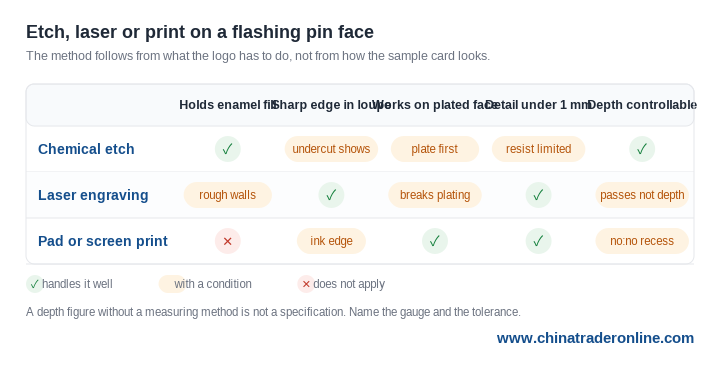
Laser engraving is naturally a marking process. It removes a controlled amount of material with each pass, exposes the base metal under a plated or painted surface, and produces the strong two-tone contrast that reads well on a lanyard. Chemical etching is naturally a recessing process. A photoresist image is developed on the metal and the exposed areas are dissolved in an etchant bath, which produces a shallow, uniform recess across the whole image, including open areas, which is exactly what a colour fill needs.
Choosing between them is therefore not a quality question. It is a question of what the logo has to do, and the answer is decided by whether colour goes into the mark.
Chemical etching: depth by time, walls that hold enamel
Etch depth is set by the bath time and the alloy, and it moves in a controllable way: a shallow marking etch and a deeper fill etch are the same process run for different durations. Two limits matter commercially.
The first is that etching is isotropic, meaning the acid works sideways at the same rate as it works down. Longer baths produce not just deeper recesses but visibly undercut walls, so the top edge of the logo can be wider than the bottom. Under a loupe this reads as a rounded, slightly soft edge; at arm length it is invisible. For a soft enamel pin that is filled and left recessed, the effect is harmless. For a hard enamel pin that is filled and then polished flush, an undercut wall shows as a thin dark line at the edge of the colour.
The second is depth consistency across one plate. A single photoresist sheet etched in one bath gives a uniform depth across the face; parts etched in separate batches can differ. Ask for the depth tolerance in millimetres and check two parts from different batches, not two parts from the same sheet.
Laser engraving: contrast fast, with a heat halo
Laser engraving is quicker to set up, needs no photoresist or acid line, and can be changed artwork by artwork, which makes it the practical choice for short runs and for personalisation. On a plated pin it cuts through the plating and exposes the base metal, and that is where two problems appear.
The first is corrosion. A laser mark through plating leaves a narrow band of bare base metal around every line. On a pin that lives on a jacket and gets handled, that band oxidises and the mark darkens unevenly. If the part is plated after marking, the sequence has to be specified, because plating over a laser mark changes both the contrast and the depth.
The second is the heat-affected zone. Around each engraved line there is a narrow margin where the surface has been heated but not removed. On painted or coated surfaces that margin shows as a faint halo or a colour shift, which is invisible on a dark body and obvious on a light one. Specify a lower power with more passes rather than a single high-power pass, and check the halo under raking light rather than straight on.

Depth numbers that mean something
A depth figure without a measuring method is not a specification. State the depth in millimetres at the recess floor, the tolerance, and how it will be measured: an optical depth gauge on the finished part, or a profilometer trace across the mark. A visual check under a lamp cannot separate a shallow fill recess from a slightly deeper one, and the difference is what the enamel line will look like in the second year.
Also state where the depth applies. A logo that crosses from a flat face onto a curved edge does not etch or engrave to a single depth, because the resist and the laser focus both behave differently on the curve. On a shaped pin, keep the engraved area flat or specify a stepped depth.
What to inspect on a sample
Four checks settle the method question faster than any specification argument. Run a fingernail across the edge of the mark: a soft, rounded lip means a deep etch with undercut, a sharp step means laser or a shallow etch. Look at the mark under a ten-power loupe for a dark halo, which identifies a heat-affected zone. Check two parts from different batches for depth difference by eye at a low angle, where inconsistent recesses show as a colour shift. And on any filled logo, check whether the enamel sits flush or recessed, since that decides the polishing step and the rejection criteria.
Browse the flashing pin range to see which bodies and logo areas these methods apply to, then send the artwork and tell us whether the logo will be colour filled, and we will specify the method, the depth in millimetres and the inspection points on the sample before the bulk run is quoted.
Sourcing products from China?
Send your product list and target quantity for a quote and a digital proof.
Get a free quote