Shower Curtain Fabrics: PEVA vs EVA vs Polyester
PEVA, EVA and polyester are the three fabrics that appear on almost every shower curtain quote, and they are not variations of one material. Two are plastics sold by thickness, one is a woven textile sold by weight, and the mix-up starts when a buyer compares a 0.10 mm PEVA curtain with a 90 gsm polyester one and asks which is heavier. The answer does not mean what the question implies, and the rest of the specification follows from getting this right.
What the three names actually mean
PEVA is polyethylene vinyl acetate, a soft plastic film with a low vinyl acetate content. It is chlorine-free, which is its main selling point against PVC, and it drapes like a light cloth rather than hanging stiff.
EVA is ethylene vinyl acetate with a much higher vinyl acetate content, typically in the mid-teens to high twenties as a percentage. More acetate makes it softer, glossier and more rubber-like, and it costs more per kilogram than PEVA. Both are chlorine-free; neither contains the phthalate plasticisers that make PVC flexible.
Polyester is a woven fabric, usually a plain weave with a water-repellent finish, and it behaves like a textile: it has a weight in grams per square metre, a colour that is dyed rather than compounded, and a drape that reads as "hotel" rather than "dormitory".

Water repellency and drape
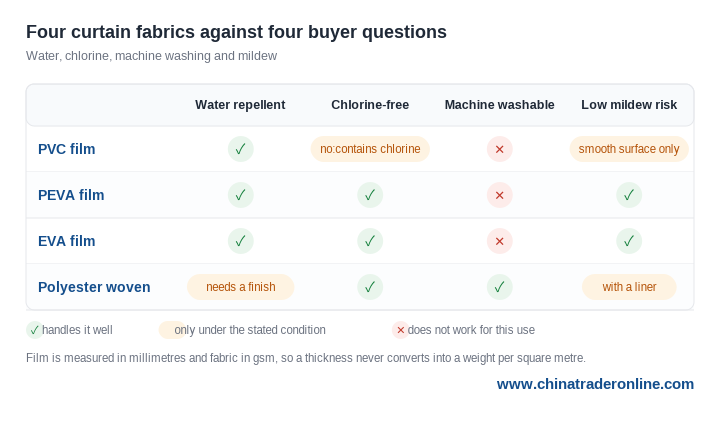
The two plastic films are waterproof by nature. A PEVA or EVA curtain does not need a finish, a liner or a care instruction beyond wiping, because there is nothing for water to soak into. That is why they dominate the low-cost and rental market: they work out of the bag, and they work for years.
Polyester is water-repellent only because it has been treated. A flourocarbon-free repellent finish makes water bead and run, but the finish wears with washing and with abrasion against the tub. A printed polyester curtain at 90 gsm will also cling to the body when the shower is running unless it has enough weight or a hem weight, and cling is the single most common complaint in reviews of fabric curtains.
Drape is the visual difference. Film curtains fall in broad, slightly stiff folds and read as functional. A woven polyester curtain falls in fine folds, holds a print properly, and photographs like a textile — which is what a hotel or a branded programme is buying. Neither is better; they are different products aimed at different shelves.
Weight and thickness are not the same number
This is where quotes go wrong. Film is measured in millimetres of thickness and fabric in grams per square metre, and the two do not convert. A 0.10 mm PEVA curtain is a light film; a 0.15 mm one is noticeably heavier and hangs better, and the difference in cost per unit is real. A polyester curtain at 80 gsm is thin enough to need a liner, at 100 gsm it stands on its own, and above 120 gsm it behaves like a proper hotel curtain.
Ask for the measurement in the unit that belongs to the material, and ask where it is measured. Film thickness varies across a wide roll, so a supplier quoting a single number is quoting a nominal figure; a tolerance of plus or minus ten percent is normal and worth writing into the spec. For fabric, ask for the weight after finishing, not greige, because a repellent finish and a print both add weight.
Mildew, washing and the liner question
Mildew grows where water sits. On a smooth film, water runs off and the surface dries quickly, so mildew is mostly a problem at the hem and the hems of the rings. On a woven fabric, moisture sits in the yarn, and a curtain that stays folded against a wet wall will grow mildew along the folds within a season. That is why fabric curtains for hospitality are almost always sold with a liner, and why the liner is specified separately rather than assumed.
Washing splits the materials cleanly. Polyester can be machine washed cold and hung to dry, which is a genuine selling point for a family buyer. PEVA and EVA cannot: heat softens the film, the curtain creases permanently in the machine, and the grommets tear out. The care instruction for a film curtain is a wipe with a damp cloth, and the product has to be designed so that wiping is enough — smooth surface, no deep embossing, sealed hems.
If the programme is aimed at hotels, specify the liner material and the ring type together with the curtain. A coated polyester liner is heavier and quieter; a PEVA liner is cheaper and dries faster. Getting the pair right matters more than the curtain print, because the liner is what the housekeeping team replaces.
Specifying a curtain for a retail programme
Five lines cover a shower curtain order, and each one has a unit that exposes a vague answer:
- Material and construction: film thickness in millimetres, or woven weight in gsm after finishing.
- Size: width by height in centimetres, with the standard 180 x 180 cm stated explicitly if that is what the market expects.
- Top treatment: buttonhole, grommet, or ring-slide, with the hole spacing in centimetres and the reinforcement named.
- Finish and compliance: repellent finish type for fabric, chlorine-free declaration for film, and the relevant migration or textile test referenced.
- Care instruction: the exact wording to be printed, because it decides whether the product can be sold as machine washable.
Add the print method: film takes a rotary print that can crack at the fold line if the ink is heavy, and polyester takes a disperse print that sits in the fibre and survives washing. A design with large solid areas of dark colour will show fold cracking on film and none on fabric, which is a reason to change the material rather than the artwork.
Send the market, the care instruction and the print, and the material follows. Fabric shower curtains for wholesale programmes are quoted per project; request a sample and a quote with your quantity and target market.
Sourcing products from China?
Send your product list and target quantity for a quote and a digital proof.
Get a free quote


