Sourcing Agent vs Direct Factory: A Cost Comparison
A sourcing agent and a direct factory can quote the same promotional product at prices that differ by a tenth or more, yet neither quote is wrong. They price different bundles of work. The agent folds in commission, coordination and the cost of watching production; the factory quotes the unit and leaves the rest to you. The right choice depends on how many products you buy, how complex they are and how much sourcing work your own team can absorb. This comparison separates the three cost lines that decide the answer - commission and margin, communication and coordination, and risk - and gives you a way to compare two quotes that look nothing alike.
1. What Each Route Actually Sells
A direct factory sells production. Its quote covers material, labour, tooling and a margin, and it assumes you will handle specifications, follow-up, inspection and freight yourself. A sourcing agent sells access and coordination. Its price includes finding the right factory, translating specifications, chasing samples, inspecting goods and often consolidating several products into one shipment. Some agents add a flat fee, others a percentage of order value, and others build their cut into the unit price. Before comparing numbers, find out what is inside each quote; a higher unit price from an agent may already include services you would otherwise pay a third party for.
2. Commission and Quoted Margin
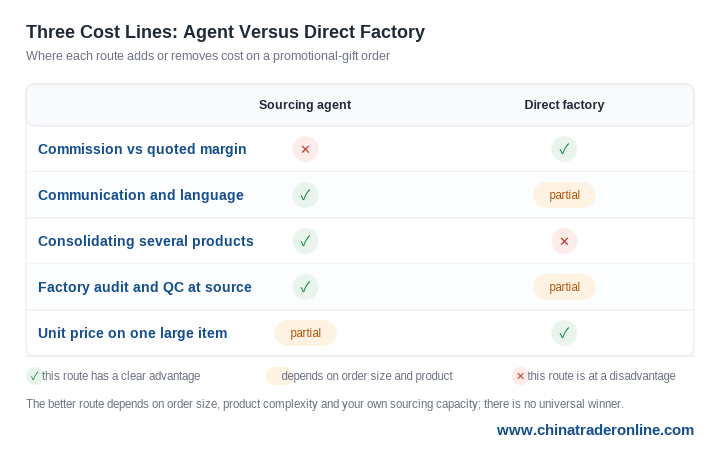
The most visible difference is the agent's commission. It is a real cost and it is legitimate - you are paying for work done. The question is whether that work is cheaper than doing it in-house. On a single large item with a stable specification, a direct relationship usually wins because there is little to coordinate and the agent's percentage adds cost without much value. On a mixed basket of small items - a pen, a bag, a notebook and a keychain - the agent's coordination can save more than the commission costs, because you avoid running four separate supplier relationships. Compare total landed cost, not the unit price on one line.

The figure below compares the two routes across the cost lines that matter. It shows direction, not a fixed saving; the numbers depend on your order and your team.
3. Communication and Coordination Cost
Sourcing across a language and time-zone gap has a cost even when no one invoices for it. Emails that need translation, drawings that are misread, and sample rounds that repeat because a detail was lost all consume time and delay a launch. A good agent absorbs much of that work and can visit a factory floor when you cannot. Against that, a direct relationship improves over time: once specifications and contacts are stable, the back-and-forth shrinks and the knowledge stays with your team. If you expect to reorder the same product for years, investing in a direct relationship can pay off; if each campaign is different, the agent's flexibility is worth more. There is also a hidden cost in switching routes. A buyer who starts with an agent to develop a product and later moves the repeat order directly must transfer the tooling, the approved sample and the accumulated production knowledge. If those are not documented and signed over cleanly, the move can stall at the factory or reproduce a sample that is subtly different from the original. Ask at the outset who owns the tooling and the artwork, and whether the supplier list can be handed to you. Clarifying ownership early costs nothing and avoids a costly dispute later, when the product is proven and both sides have an interest in keeping the relationship.
4. Risk and Who Carries It
Risk allocation differs as much as price. With a direct factory, you own specification errors, inspection and the consequences of a bad batch, though you also deal with the factory directly when something goes wrong. An agent who inspects goods and confirms samples before shipment can catch problems early, but you must define in writing what the agent is liable for; a claim that the goods were checked is not a warranty unless the scope is specified. Consolidating goods through an agent also reduces the chance that one late supplier holds the whole campaign. Decide which risks you want to keep and which you want to pay someone else to manage, then price that decision into the comparison.
5. A Fair Way to Compare Two Quotes
Put both proposals on the same footing. List the unit price, tooling, samples, inspection, freight consolidation, payment terms and the internal time each route demands. Add the cost of a defect or a late shipment at an expected rate, not a theoretical worst case. Where the agent's quote includes inspection and consolidation, price those services separately in the direct-factory column so the comparison is honest. Then choose based on your situation: many small items and limited sourcing capacity favour an agent; one large stable item and an experienced team favour a direct factory. Send us your product list and target quantities, and we will prepare a landed-cost comparison for both routes.
Sourcing products from China?
Send your product list and target quantity for a quote and a digital proof.
Get a free quote