Car Gadget Wholesale: 5 Voltage and Fit Checks
A car gadget that sells in one market and gets returned in another is usually a voltage or a fit problem, and both are visible on the sample bench in less than an hour. The buyer who tests five things — range, cranking dip, plug fit, fuse, mounting — stops guessing which SKU will fail in which country, because the failure is decided by the vehicle's electrical system and the socket it was designed around, not by the product's appearance.
These checks are for buyers assembling a car accessory line from mixed suppliers, assuming both a 12 V car and a 24 V truck are in your market.
Voltage is a property of the vehicle, not a spec you choose
A "12 V" socket is a nominal figure. With the engine running and the alternator charging, a passenger car sits somewhere above that nominal value; when the starter engages, the same circuit dips well below it for a fraction of a second, and the accessory sees both. A device that only works at a steady nominal voltage is a device that resets every time the owner starts the engine — and that reads as a defective unit, not as a design limit.
Twenty-four volt systems in trucks and buses have the same behaviour at double the numbers, which is why a dual-voltage device is not just a marketing label: the input stage has to regulate across both windows and survive the transients on top. Ask the supplier what the input range is in writing, and ask what the device does when the input falls below the range — shutdown and restart, or a brownout flicker. The second answer is the one that generates returns.
Test one and two: sweep the range, then dip it
Put the device on a bench supply and raise the voltage slowly from the bottom of its stated range to the top, watching for a reset, a flicker or an audible change in a motor or a fan. Then drop the voltage quickly to simulate cranking and bring it back. A device that restarts cleanly is acceptable for a phone charger; a device that restarts with its settings lost is not acceptable for anything with a memory, a timer or a paired connection.
If you do not have a bench supply, the field version of this test costs nothing: test in three vehicles, one of them a diesel, and start the engine with the device plugged in and running. Do it five times. Any device that resets on start will be reported by customers as "stops working when I start the car", and no amount of instruction-sheet wording fixes that.
Test three: the plug against a real socket
Socket depth and spring tension vary with age, and a plug that fits a new demonstrator can sit loose in a ten-year-old socket. Push the plug fully home in three vehicles and try to wobble it sideways — a plug that rocks will lose contact on a bump, and the contact loss is often brief enough to look like an intermittent fault rather than a loose fit.
Check the barrel and the tip separately. The tip contact is a spring-loaded pin on most designs; if it is too short, the plug seats but does not connect. If it is too long, the plug stands proud of the socket and the body catches on the console. Then check the body diameter against a socket that has a raised lip or a deep recess, the kind found under an armrest or inside a console bin. This is the single most common fit complaint for splitters and multi-way adapters, because the splitter body is longer than a simple plug.

Test four: the fuse, and what it is protecting
Most plug devices carry a fuse in the tip or the body. Confirm two things: that the rating is printed on the device or the plug, and that the fuse can be replaced without destroying the housing. A fuse that is soldered in, or a housing that is glued shut, turns a one-dollar part into a whole-unit return.
Then think about what the fuse is protecting. It protects the vehicle's circuit, not your device — so it should be sized to the device's draw with headroom, not to the maximum the socket can deliver. If a supplier cannot tell you the current draw at both voltages, the fuse was chosen by habit rather than by calculation, and that is a reasonable reason to ask for a revised sample.
Test five: cable, mounting and heat
Measure the cable from the socket to where the device will actually sit, not to where it sits in a photo. A socket in the console and a device on the windscreen are far apart; add the routing around a seat or an airbag cover and the required length grows again. Then check the mounting: a suction cup that holds on glass at room temperature can release on a hot dashboard, and an adhesive pad that holds on a clean surface can fail on a textured one.
Heat is the quiet failure. A plug left in a socket in a closed car in summer runs hot, and a device with no thermal cut-off or heatsink has nothing to do about it except age faster. Touch the body after twenty minutes of operation at the highest voltage in its range — a body that is uncomfortable to hold is a body that will deform or discolour in service.
Put the five checks on a sample sheet
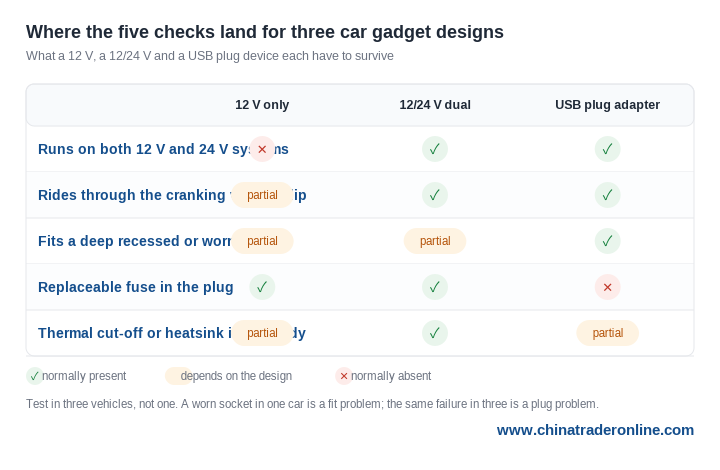
Write the results as pass or fail with the vehicle named: voltage range tested and behaviour at the dip, number of sockets the plug fitted and whether it rocked, fuse rating and whether it is replaceable, cable length measured end to end, and the temperature of the body after twenty minutes. Keep one tested unit per SKU as the reference for the next shipment.
That sheet is what turns a mixed car accessory line into a range you can sell into both passenger and commercial markets. Browse the car gadgets range to see which designs already state a dual-voltage input — those are the SKUs that need the fewest checks before you commit to a container.
Sourcing products from China?
Send your product list and target quantity for a quote and a digital proof.
Get a free quoteRelated products
Cigarette Lighter Adapters with Input Voltage of 12 and 24V DCCTO21163
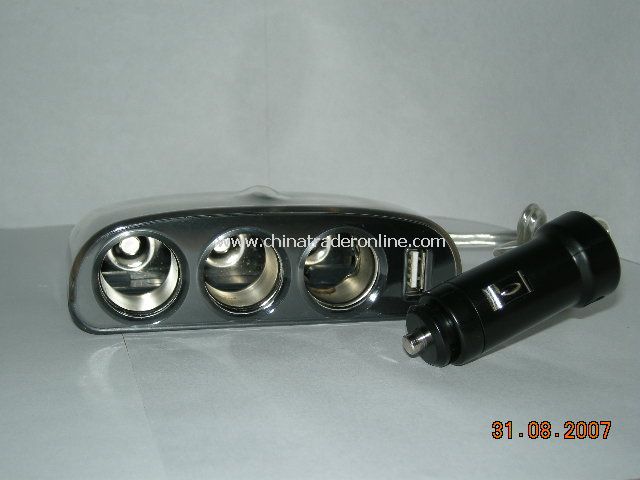 3 Way USB Car Cigarette Lighter Charger Socket AdapterCTO31539
 1 to 3 Triple Car Cigarette Lighter Power Splitter with USB PortCTO64744
 Car Cigarette Lighter Powered 10-in-1 3W 580~600LM 10-LED Blue Light Lamp (12V)CTO65102
 Car Cigarette Lighter Powered Electric Water Heater Bottle - Black (280ml / DC 12~24V)CTO65128