iPhone Accessory Compatibility: 4 Checks Before Tooling
Tooling a phone accessory before checking four things is how a factory ends up with a mold that fits last year's model. The four checks below — dimensions and cutouts, port opening, magnet array, and certification — are the ones that decide whether a case, holder or dock still sells when the next model lands, and three of them can be settled with a gauge and a printed drawing rather than with a sample.
Why Four Checks Beat One Sample Fit
A sample that fits the phone on the buyer's desk proves the dimensions for that one model. It says nothing about the port opening for a third-party plug, nothing about whether the magnet ring sits where the phone's coil sits, and nothing about what the product is legally allowed to claim on the box. Each of those is a separate decision, and each one is expensive to change after the mold is cut.
The order matters: dimensions and port first, because they set the mold; magnets second, because the pocket for the ring is cut into the same tool; certification last, because it decides the packaging and not the shape.
Check 1: Dimensions and Cutouts per Model
Ask for the phone's published dimensions and then measure a real handset at three points — height, width and the camera island — with a caliper, because published figures round and the camera bump is the dimension that matters most for a case. Then draw the cutout positions on the tool drawing and check them against the handset: side buttons, mute switch, speaker slots, camera lenses and the flash.
The commercial decision sits underneath the technical one: every model generation is a separate tool. A snap-on case for four models is four molds, so the SKU count has to be decided before the drawing is approved, not after. Most buyers start with the two models that carry the volume and add the rest on a second run.
Check 2: The Connector and the Port Opening
Apple moved the iPhone from Lightning to USB-C with the iPhone 15 generation, and that change is not just a different socket — it changes the shell depth around the port, the clearance needed for an overmolded cable, and the internal space for a dock's connector block. An accessory tooled around a Lightning plug will not accept a USB-C plug, and the reverse is also true.
Make a port gauge: a block with the plug's outer profile machined into it, pushed into the opening at the angle a user would use. If the gauge enters without forcing the shell, the opening is right. If it needs a push, the wall will crack at the port within a few months of daily plugging, which is the most common structural complaint in this category.
Check 3: Magnet Arrays and Alignment
If the accessory is a magnetic mount, holder or wallet, the magnet ring has to sit on the same axis as the phone's charging coil. Ask the supplier for the ring's inner and outer diameter and its position measured from the bottom edge of the phone, then compare those figures with the phone's own published alignment geometry before the pocket is cut.
Two failure modes follow from getting this wrong. A ring that is off-centre holds the phone at an angle, so a car mount lets it rotate. A ring that is too weak for the phone's mass drops the handset on the first bump — test it by mounting a phone with the case on and driving over a speed bump at low speed, or by shaking the mount by hand for thirty seconds. Magnets are also the one part where a sample can mask a production problem, because the factory may hand-place the first pieces and glue them in production.
Check 4: Certification and What You May Claim
Anything that carries a plug, a coil or a charging circuit sits inside Apple's accessory ecosystem rules. A Lightning or USB-C connector sourced through the licensed program comes with a certification path and a chip; an unlicensed connector can still charge, but the product cannot use the program's marks, and it may trigger a compatibility warning on the handset.
Decide before tooling which route you are on, because it changes the bill of materials and the packaging text. Then write down what the product is allowed to say: "compatible with" is a factual statement about fit, while any claim about charging speed or certification has to be backed by the test report for the parts actually used.
From Check to Tool: What to Freeze
Before the mold is cut, freeze five things in writing: the model list and their camera geometry, the port gauge result, the magnet ring dimensions and position, the connector source with its certification status, and the packaging claims. A change to any of the five after tooling is a new tool or a new part, and at that point the schedule belongs to the mold, not to the buyer.
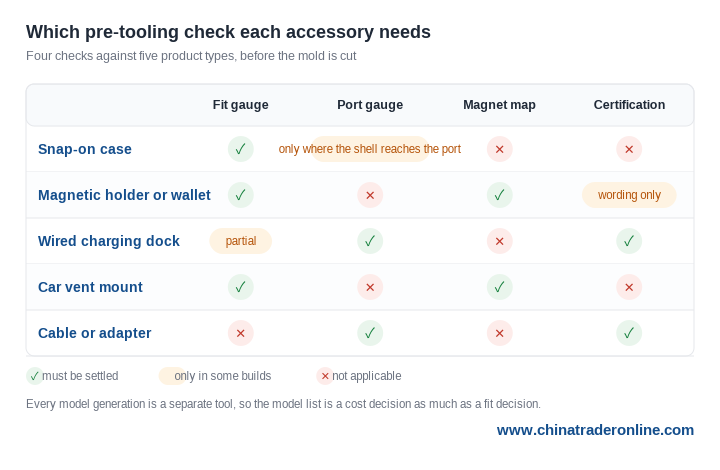
Run the checks against the specific models you intend to sell, then order a tooled sample for the top two and fit it to a real handset with the customer's own cable. When you source iPhone accessories for a program, send the model list with the enquiry — a supplier who asks for it before quoting is a supplier who has cut these tools before.
Sourcing products from China?
Send your product list and target quantity for a quote and a digital proof.
Get a free quote