Product Photo and Spec Sheet Standards for Resale
Most listing delays are not caused by the product. They are caused by assets that arrive in the wrong shape: a photo with a busy background, no sense of scale, or a spec sheet missing the two fields the marketplace requires. Give the factory a delivery template up front and three review rounds usually collapse into one.
The three photos every SKU needs
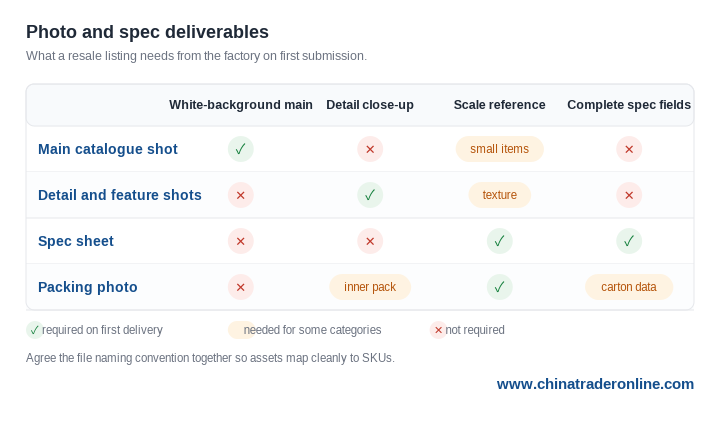
Require a clean white-background main image, one or two detail close-ups, and at least one image that establishes scale. The main image is reused across catalogue, search and comparison pages, so it must show the whole product without props or heavy shadow. Detail shots earn their place by showing a feature a buyer cannot infer from the silhouette: a mechanism, a surface texture, a joint.
Scale is the most often omitted. A pen, a keyring and a small lamp can photograph at the same apparent size, and the buyer has no way to tell them apart. Include a familiar reference object or a dimension overlay, and keep it consistent across a category so comparisons stay honest.
A shooting setup that survives resizing
Listings crop images into squares, banners and thumbnails. Shoot with a plain background, even lighting and the product centred with margin around it, so a crop does not cut off an edge. Capture at high resolution and let the listing platform resize down; upscaling a small source always looks soft.

For metallic or glossy surfaces, ask for a polarised or tent-lit shot to control glare. Dark products need a slightly brighter exposure so details do not disappear when the image is small. These are setup instructions, not retouching; keep the product true to colour so the photo matches what ships.
The spec sheet fields that matter
A useful spec sheet is short and fixed. Require the exact product name and SKU, the material and finish, overall dimensions with units, net and gross weight, the colour or variant list, the minimum order quantity, the packing configuration and any compliance documents available. Leave no field blank: write not applicable where it does not apply, so the reader knows it was considered.
Numbers must be measured, not copied from a supplier catalogue. Confirm dimensions against a physical sample and state the tolerance where it matters, because a listing that quotes the wrong size generates returns.
File naming and delivery
Agree one naming convention before the first shoot. A workable pattern is SKU followed by view type and sequence, so files sort into groups automatically and map directly to the product database. Deliver images and the spec sheet together in one folder per SKU, with a short manifest listing what is included. Missing assets are then obvious at a glance.
Ask for the editable source where practical, and keep a master copy of each approved image. When a variant is added later, the same setup and naming make it straightforward to extend the set.
The three most common causes of rework are all avoidable at the brief stage. The first is a main image whose crop changes between SKUs, so a category page looks inconsistent even though each photo is fine on its own; fix the framing and margin in the template. The second is a spec sheet filled in by copying a similar product, which quietly carries over the wrong dimension or material; require each value to be measured and signed off against the sample. The third is an asset set delivered with no manifest, so a missing scale shot is discovered only when the listing is ready to publish. A one-line checklist included in the folder removes that guesswork.
None of this requires professional photography equipment. A consistent light source, a plain background, a tape measure in frame and a fixed file convention cover the needs of most resale catalogues. What matters is that the same rules are applied to every SKU in a range, so buyers can compare products fairly and your team can publish a listing without chasing the factory for a replacement image at the last moment.
A one-page template to send
Put the three required photos, the mandatory spec fields, the naming rule and the packing-photo requirement on a single page, then attach one finished example as the reference standard. A supplier who can follow one example will produce a usable first delivery far more often than one working from a written description alone. For category context, browse the promotional gifts range.
Set a realistic turnaround for the asset delivery and build it into the production schedule. Asking for photos on the same day the goods ship invites a rushed shot on a factory floor, which is exactly the kind of image that gets rejected. A short window after the pre-production sample is approved works well: the product is final, the line is not yet busy, and there is time to reshoot a frame that comes out poorly. Treating assets as a scheduled deliverable, rather than an afterthought, is the single change that removes most listing delays.
Send us a SKU and its target marketplace, and we will return a filled-in asset template you can hand to your factory.
Sourcing products from China?
Send your product list and target quantity for a quote and a digital proof.
Get a free quote