Flashing Pins and Badges: Battery and LED Life Tests
A flashing pin that dies halfway through an event costs more than its unit price, because the buyer cannot replace a sealed battery on site. The two specs that decide this are the battery type and the LED life of the assembled pin, not the rating printed on the LED chip. This guide gives the three power options, the test that measures real runtime and the battery clause to put in a wholesale order.
Start With the Length of the Event
How long must the pin flash, and can the buyer change the battery during that time? A one-day promotion can use a button cell and accept that the pin is single-use. A multi-week event or a reusable staff badge needs a longer-life source or a design whose battery can be swapped. Decide the event length first, because it rules out most of the options before you look at unit price.
Write the required flash duration into the enquiry in hours, not days. A supplier who hears "long lasting" will quote whatever is cheapest; a supplier who hears "eight hours of continuous flash" will quote the battery that meets it. The number also gives you a basis for a claim if the delivered pins fall short.
Three Power Options Compared
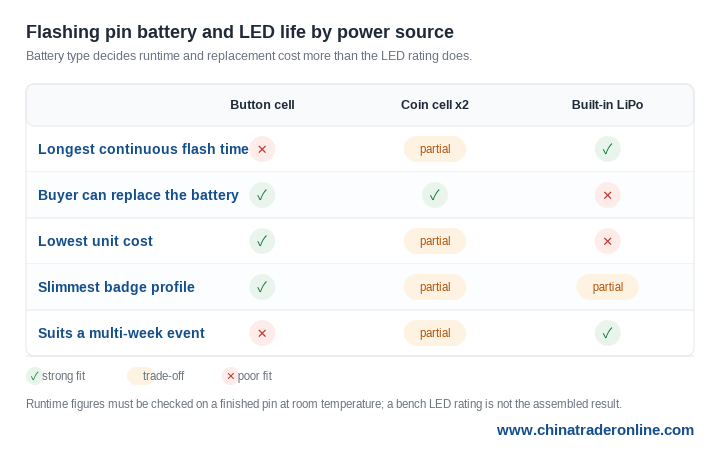
A single button cell is the cheapest and thinnest option, and it suits a short promotion where the pin is discarded afterwards. Two coin cells give more runtime and can often be replaced by the buyer with a coin and a screwdriver. A built-in rechargeable lithium polymer pack lasts longest and survives many events, but it cannot be swapped and adds cost and a charging step.
The matrix below scores the three options on runtime, replaceability, cost, thickness and suitability for a multi-week event. Confirm the figures on a finished pin, since an LED rated for a long life in a bench circuit can behave differently once it is sealed in a badge with a resistor and a small battery.
How to Test Real Runtime and LED Life
Run the test on a finished pin at room temperature. Switch it on and time how long it flashes before the light drops below a level you would still call visible. Note whether the light fades gradually or cuts out suddenly; a gradual fade means the buyer sees a dim pin for hours before it fails. Test three pins from different boxes and use the shortest result as the real figure.
For LED life, leave a pin flashing for a full day and check that the brightness and the flash rate stay even. A flashing circuit that speeds up or skips as the battery drains will look faulty to the recipient even while it technically works. If the pin is sold with a logo overlay, check that the light still reads through it after the battery has dropped to half.
Storage and Shelf Life Before the Event
Flashing pins are often made weeks before they are handed out, so what matters is the charge left after storage, not the runtime on the day of manufacture. Ask the supplier whether the batteries are fitted at production or inserted at packing, and whether the pins ship with an insulating tab that prevents drain in transit. A pin without a tab can arrive flat after a long sea journey even though it tested well at the factory.
Store the pins in a cool place and check a few from each carton a week before the event. If they have dimmed, replace the batteries or reorder rather than discovering the problem on the day. For a reusable badge programme, include spare cells in the order and a simple tool to open the compartment, so the buyer can refresh a batch between events without sending it back.
Battery Safety and the Purchase Order
If the pin ships with a lithium cell, ask for the transport documents the carrier requires and confirm them before the order, not at the freight stage. A battery declaration that is missing can hold a whole shipment at the port. Ask the supplier which cell is fitted and whether the model may change, since a substitution changes both the runtime you tested and the documents you prepared.
Put three lines in the order: the battery type and model, the minimum flash duration in hours, and the rule that no cell substitution is allowed without a new sample. Add a clause for how a dead pin will be replaced within the event window. For buyers building a wider programme, our flashing pin range covers the formats these power options fit. Send us your event length and target quantity and we will quote each power option with its tested runtime and the battery clause written into the spec.
Sourcing products from China?
Send your product list and target quantity for a quote and a digital proof.
Get a free quote


