Payment Terms in China Sourcing: 30/70, LC and Trade Assurance
Payment terms are where a sourcing relationship is actually priced. The percentage in front of the slash decides who funds the materials, who carries the risk while the goods sit in a container, and whether you have any leverage if the shipment arrives wrong. Three structures cover almost every order: a telegraphic transfer split, a letter of credit, and a platform escrow. Each is right for a different order size and a different stage of the relationship.
What the deposit is actually paying for
A deposit is not a gesture of commitment, it is working capital for materials. On a custom programme the factory buys fabric, components and packaging before it produces anything, and the 30 percent covers that purchase. So the percentage moves with the product: a standard item made from stock materials can run on 30 percent, a custom item that needs a mould or a printed carton often needs 50, and a small order of a few thousand dollars is frequently quoted at 100 percent up front because the administration costs more than the margin.
That framing gives you the negotiating question. Instead of arguing about the percentage, ask what the deposit is buying and when it is spent. If the answer is that materials are ordered on day one, the deposit is legitimate; if the answer is that the deposit is company policy, the percentage is a cash-flow preference and there is room to move. The same arithmetic holds across the promotional gifts range, where a printed carton often adds a second material purchase.

30/70 T/T, and the variant that changes the risk
The standard split is 30 percent on order confirmation and 70 percent before shipment. The second half is where the risk sits, and the exact wording decides who carries it. Paid before production finishes, the buyer funds goods they have not seen. Paid against a copy of the bill of lading, the goods are already on a vessel and the buyer holds a document that proves shipment, which is a materially better position for the same headline percentage.
The strongest version of the split puts the balance after a passed inspection rather than after packing. Something like 30 percent deposit, 60 percent after the pre-shipment inspection passes, and 10 percent after the documents are accepted gives the buyer a real lever at the last moment the factory still controls the outcome. Factories accept this more readily than buyers expect, because the money still arrives before the container sails.
Watch the currency and the bank charges. An order in US dollars paid from a third currency carries two conversions, and intermediary bank fees are deducted from the amount received, leaving a shortfall the factory will invoice again. State that the beneficiary receives the full invoiced amount and that charges outside the receiving bank are for the sender.
Letters of credit: when the bank fee buys something
A letter of credit replaces trust with documents. The bank pays against a set of documents that match the credit exactly, which protects a buyer who has no relationship with the supplier and a supplier who has no relationship with the buyer. The cost is real: issuance, advising, amendment and discrepancy fees, plus the operational cost of getting every document exactly right. A credit that names a detail inconsistently with the invoice is a discrepancy, and a discrepancy usually means a fee and a delay.
The economics only work where the fees are small against the value of the protection. For an order in the low tens of thousands of dollars, a transfer split with an inspection is cheaper and just as safe. For a first order of real value with a supplier nobody has used, a credit is a fair price for removing the counterparty question.
Keep the document list short and boring: invoice, packing list, bill of lading, and an inspection certificate if you use an inspector. Every extra document is another chance to fail on a technicality.
Trade Assurance and platform escrow
Platform escrow holds the payment and releases it according to the transaction terms, with a dispute process if the goods do not match the specification. For a first order with a supplier found on a marketplace, it is often the cheapest protection available, because the cost sits inside the platform rather than on an invoice.
The limits matter. Protection usually runs to the amount and specification recorded in the platform order, so anything agreed by email and never entered on the order page sits outside it. The dispute window is finite, so the inspection has to happen inside it, and a claim needs photos, the specification and an inspection report referencing both. Treat the order page as the contract, because in a dispute it is.
Open account, credit insurance and the long game
Open account, on 30 or 60 day terms, is what suppliers offer buyers they have shipped to for years without a problem. It is not a concession for a first order, and asking early reads as a credit risk. When it does open up, the exposure is usually covered by export credit insurance, priced against the buyer country and history.
The route to open account is a sequence: one order on a transfer split with an inspection, two or three more on the same terms, then 20 percent in advance with the balance at 30 days. Each step is earned by a clean shipment, and the sequence takes a year of ordering rather than one negotiation.
The clause that matters more than the percentage
Whatever the split, the sentence that decides the outcome is the one about failure. A term without a defined inspection, acceptance standard and remedy is a schedule rather than a protection. Write three things beside the percentage: the stage at which the balance falls due, the standard the goods are measured against, and the remedy, whether rework, price adjustment or replacement.
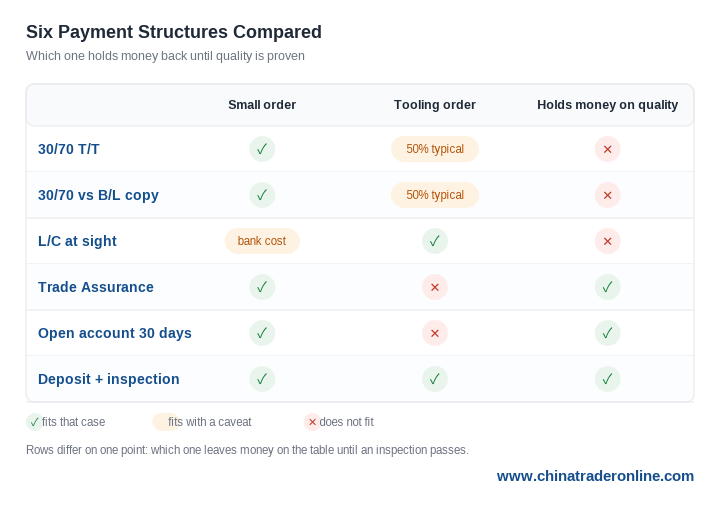
A supplier who resists an inspection-linked balance is telling you something about how confident they are in the run. A supplier who accepts one, and puts it in the contract, has just given you a better term than any discount on the deposit.
Sourcing products from China?
Send your product list and target quantity for a quote and a digital proof.
Get a free quote