Flashing Pin Payment Terms: 30/70, LC and Trade Assurance
A flashing pin order is not a plain goods order. It carries a mould or a print plate, a battery, an LED module soldered to a PCB, and a plating finish that shows wear before anything else does. That mix is why the usual 30/70 terms, an LC, or Trade Assurance each protect a different part of the deal — and why buyers who copy a payment clause from a T-shirt order end up exposed on the tooling.
What Is Different About a Pin Order
Four cost blocks sit inside one unit price: tooling, the LED and battery assembly, the metal body with its plating, and the print or epoxy dome. Only the last two scale cleanly with quantity. Tooling is fixed, and the LED module has a minimum purchase quantity of its own, which is why small pin orders are dominated by fixed costs and why the deposit matters more here than on a bag or a notebook.
Tooling is also the part of the deal that is hardest to recover if the order goes wrong. A mould cut for a custom shape has no resale value to the factory, so the supplier wants it paid early, while the buyer wants it held back until the sample is approved. Most disputes on pin orders start exactly there.
The 30/70 Split Applied to Tooling and Goods
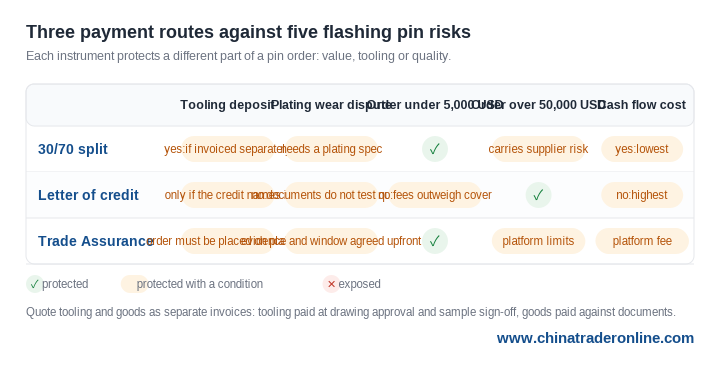
The standard split is 30 percent deposit with the order and 70 percent against the bill of lading or before shipment. On a pin order, split the payment into two invoices instead of one: a tooling invoice and a goods invoice. The tooling invoice can be paid 50 percent at drawing approval and 50 percent at sample sign-off, which keeps the mould moving without handing over the full amount before you have seen a part.
Keep the goods payment tied to a document, not to a date. The usual trigger is a copy of the bill of lading, or a passed inspection report plus packing photos. A date-based trigger removes your leverage, because the goods can ship late and the payment still falls due.
Write the tooling ownership line into the same document. State that the mould belongs to the buyer, that it is kept for two years, and what happens to it if no reorder is placed. Without that line, a reorder two seasons later often means paying for the tooling twice.
LC for a Pin Order: Description Pitfalls
A letter of credit looks like the safest instrument and is the easiest to fail on documentation. Banks check documents against the credit wording, not against reality, so a description mismatch is a discrepancy even when the goods are correct.
Two mismatches recur on flashing pins. The first is the product description: the credit says LED badge, the invoice says flashing pin, and the bank treats them as different goods. Use one term across the credit, the invoice, the packing list and the bill of lading, and add the model reference if there is one.
The second is the battery. Button cells inside a pin are declared goods for air freight, and a credit that does not mention batteries can be rejected when the air waybill carries a battery statement. Decide the shipping mode before the credit is issued, then write the description to match the documents that mode produces.
Cost is the third consideration. LC charges typically run from a fraction of a percent to well over one percent of the credit value depending on the bank and the confirmation, and they are paid whether or not the goods are good. For an order under a few thousand dollars, the fee and the documentation work usually cost more than the protection is worth.
Trade Assurance and Plating Wear Claims
Trade Assurance works on evidence, and plating wear is the claim most often lost because the evidence is a photograph taken three months after delivery. A pin that has been worn at a trade show for a week shows edge wear that a factory will call normal use, and without an agreed specification there is no standard to measure against.
Fix that before the order by writing a plating specification with a thickness figure and a salt-spray or wear reference, and by agreeing a sample that is kept by both sides. Then a claim becomes a comparison against a joint standard rather than an argument about whether the wear is excessive.
Note the claim window as well. Most platforms require a dispute to be opened within a defined period after delivery, so schedule your own inspection to finish inside it. An inspection that happens after the window closes gives you information but no remedy.
Writing Payment Terms Into the Purchase Order
Put six lines in the PO: deposit percentage and trigger, balance percentage and trigger, tooling invoice treatment, tooling ownership, inspection standard with sample retention, and the claim window. Each line is short, and together they remove most of the room for a later disagreement.
Attach the approved sample reference to the payment clause rather than to a separate quality annex. When the balance release is tied to a passed inspection against that sample, the quality document becomes a payment document and gets read by the person who controls the money.
Finally, match the instrument to the order value. Under a few thousand dollars, a card or a platform payment with a documented inspection is usually cheaper than an LC. Above that, an LC or a confirmed platform order earns its cost, but only if the description matches the shipping documents exactly.
Browse the flashing pin range for body shapes and plating options, then send your order value and tooling scope and we will set out the payment structure line by line.
Request a free sample and quote with your pin design, quantity and preferred payment route, and we will quote tooling and goods separately so the terms are easy to compare.
Sourcing products from China?
Send your product list and target quantity for a quote and a digital proof.
Get a free quote


