Flashing Pin Sourcing Calendar: 6 Lead Times to Plan Around
A flashing pin order is small, cheap per unit and almost always tied to a fixed date: a concert, a trade show, a product launch, a holiday campaign. That combination is what makes it fail. The unit cost is low enough to leave the schedule unattended until the last month, and the date is fixed enough that a two-week slip means the goods arrive after the audience has gone home. Six lead times decide whether the order lands, and each one has an owner.
1. Artwork Freeze: Before the Quote, Not After
The pin itself is usually a stock housing with a printed or moulded face, so the artwork is the custom part. Freeze it before the price is agreed, because the print file decides the process: a flat two-colour logo can go on a printed insert, a gradient needs a different route, and a shaped outline may need a new housing rather than a new print. Include the battery specification in the same freeze, since a pin with a replaceable button cell ships differently from one with a sealed cell.
Practical rule: allow three to five working days for the file to be checked and returned with a proof at final size, and treat the approved proof as revision one of the order.
2. Sample Round: One Week Plus Courier
A pre-production sample is usually about a week from approved artwork, and the courier is another three to five working days. That is one full working week of calendar time for the fastest possible loop, and it is the step most often skipped when the date is tight. Skipping it moves the risk to the bulk run, where the cost of being wrong is the whole order rather than one pin.
If there is genuinely no time for a sample, the alternative is not to skip it but to shorten it: ask for a photo proof of the first off-tool piece against the approved artwork, and hold the balance until that photo is accepted in writing.

3. Production Slot: Counted From the Deposit, Not From the PO
Factories schedule from the deposit, not from the purchase order date. If the deposit clears on a Friday and the slot is counted from the PO two weeks earlier, the delivery date in the contract is already fiction. On printed light-up pins the bulk run is typically two to three weeks after deposit and approved sample, longer if the housing is new or the print needs a new screen or mould.
Ask for the slot in writing when the deposit is arranged, and put both dates in the order: deposit received, and goods ready for inspection.
4. Holiday Shutdown: The Deadline Nobody Diaries
Chinese New Year moves every year, and the factory effectively closes for longer than the public holiday: workers travel early and return late, and the week before the break is lost to rush orders. A pin that must ship in February has to be in production before the shutdown, which means the deposit and the artwork freeze both land in December or early January.
Treat the shutdown as a hard wall rather than a soft one. Two other windows behave the same way at smaller scale: the National Day holiday in early October and the May holiday, both of which shorten a production month by about a week.
5. Freight Booking: Air Is Fast Until It Is Not
Air freight is five to eight days door to door in normal conditions, and sea freight is twenty-five to thirty-five days to a European or US port before customs. The trap is capacity, not transit time: the weeks before a major trade show or a gift season are when space is tightest and rates move fastest, and a booking made late pays more for a later slot.
Battery content changes the booking, not just the paperwork. A pin with a sealed lithium cell needs a dangerous goods declaration and a test summary before the carrier accepts it, and some carriers take it on cargo aircraft only. Dry-cell and button-cell pins avoid that queue entirely, which is worth knowing at the design stage rather than at the booking stage.
6. Venue Buffer: The Date the Goods Must Physically Arrive
The last lead time is the one buyers forget to write down: not the ship date, but the date the cartons have to be at the venue, the warehouse or the fulfilment centre. Work backwards from that date rather than forwards from the order. Seven days of buffer covers a customs query or a re-delivery; two days covers nothing, and a missed event is not recoverable at any price.
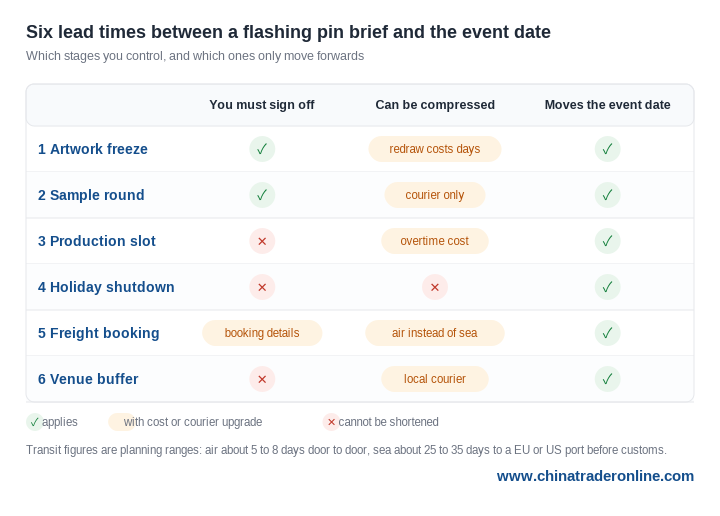
Building the calendar backwards: start with the venue date, subtract seven days of buffer, subtract the freight transit, subtract the production slot, subtract the sample round, and the result is the date the artwork must be frozen. If that date is already in the past, the honest options are a faster freight mode, a stock housing instead of a custom one, or a later event. Knowing which one to trade away is the whole point of writing the calendar down. Send the event date and the artwork, and we will lay the six dates out for your project and name the one that has to move first. Browse the flashing pin range to see which housings can skip the tooling step.
Sourcing products from China?
Send your product list and target quantity for a quote and a digital proof.
Get a free quote
-22195324164.jpg)

