Private Label Tooling: 4 Fixed Costs in Any Custom Product
Every custom product carries four fixed costs that do not fall when the order gets smaller and do not always disappear when the order gets bigger. They are the reason a quote for 500 custom-shaped items can look unreasonable next to a stock item at the same unit price, and the reason the second order is dramatically cheaper than the first. Knowing what the four are, and what each one locks you into, is the difference between a tooling charge you planned for and one that arrives as a surprise.
Fixed cost one: the mould
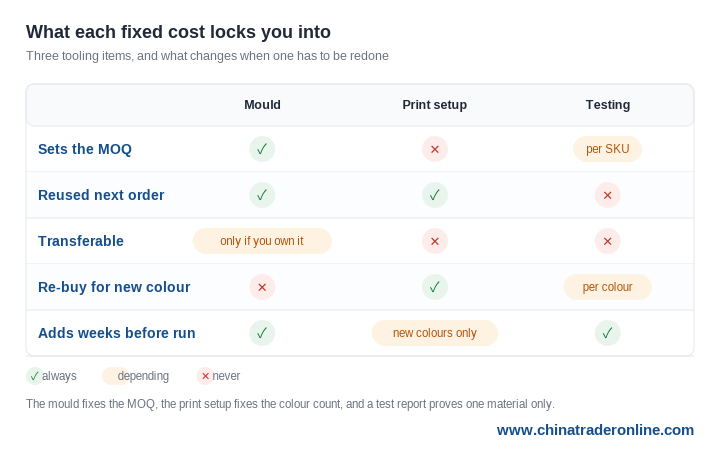
A custom body shape needs a tool. For an injection-moulded item that means a mould cut to your geometry, and the mould's cost is driven by the number of cavities, the complexity of the shape, the surface finish and the steel or aluminium it is cut from. Cavity count is the number that matters commercially: a single-cavity mould is cheaper to cut but produces one part per cycle, so the unit price stays high at volume. A multi-cavity mould costs more up front and brings the unit price down, which is why the same product can be quoted at two very different unit prices depending on the tool the supplier intends to use.
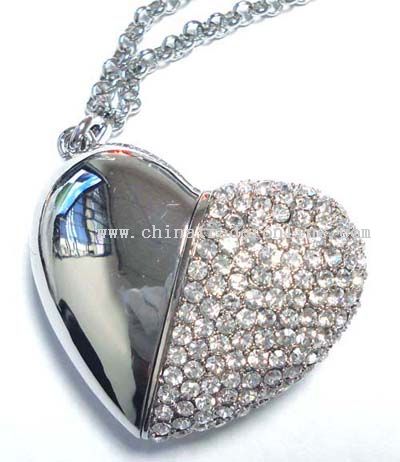
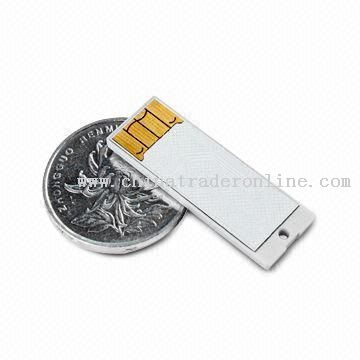
Ask two questions and the quote becomes comparable. How many cavities, and is the mould cost included in the unit price or invoiced separately. A supplier who amortises the mould into the unit price is offering a lower headline number and a higher unit cost forever; a supplier who invoices it once is showing you what you are actually buying. It is also worth checking whether the shape can come from a standard USB products body, because a stock body removes this cost entirely and leaves three fixed costs instead of four.

Fixed cost two: artwork and print setup
Logo application has its own setup, and it is charged per process, per colour and per position. Pad printing needs a cliché per colour. Screen printing needs a screen per colour. Laser engraving needs a program and a fixture to hold the part in the same place every cycle. Heat transfer needs a plate or a digital setup. Two colours on the front and one on the back is three charges, not one, and moving the logo to a different position adds another.
This is the cost that reappears most often, because it is triggered by change rather than by volume. A new colour, a new position, a new logo for a second customer, or even a different Pantone match can require new setup. When you plan a programme with several artwork variants, plan the setup charges as a per-variant cost and price them into the deal.
Fixed cost three: samples and approval rounds
Prototype or pre-production samples are made outside the production run and are paid for separately, often at a multiple of the unit price, plus courier. They are not free and they should not be treated as free: a supplier who sends three rounds of samples at no charge has either absorbed the cost into the unit price or is not running a proper sample process.
Each round also costs you calendar time, which is the part that rarely gets modelled. A round of samples plus shipping plus your own review can consume weeks, and if the sample fails, the next round consumes them again. The way to keep this cost down is to send one complete specification with the artwork files, the Pantone references, the material and the finish, so the first sample is a real test rather than a conversation.
Fixed cost four: testing and compliance
A test report is charged per material, per colour and per test scope, and it does not carry over to a different moulding or a different supplier. On a custom product the report is often the last item on the list and the first one a buyer needs, because the item cannot ship into some markets without it. Budget it as a fixed cost alongside the mould, and decide early which markets the product has to enter, since that decision sets the test scope.
Amortising the four, and who owns the tool
The standard approach is to divide the total fixed cost by the planned quantity and add it to the unit price. That works if the quantity is real. If the programme is cut in half, the amortised figure was too low and the supplier either absorbs a loss or renegotiates, and both outcomes cost you. A more honest structure is to invoice tooling once, separately, and keep the unit price clean; the fixed cost then belongs to the order that caused it, and the next order starts from a real unit cost.
Ownership matters as much as the amount. Ask who holds the mould, whether it is transferable, and what happens to it if you move to another supplier. A mould you paid for but cannot take with you is not an asset, it is a hostage. Put the answer in writing, including the mould's expected life in cycles, because a tool that wears out in the middle of a repeat order creates a second invoice you did not plan.
What to put in the RFQ
Five lines make a fixed-cost quote usable. The tooling items listed separately with the cavity count. The print setup broken down by colour and position. The sample rounds and their cost, including courier. The test scope and which market it covers. And the ownership and life of the mould. With those five, two quotes for the same custom product become a real comparison instead of a guess about what was included.
Sourcing products from China?
Send your product list and target quantity for a quote and a digital proof.
Get a free quote