Electronic Gadgets MOQ: How to Order 6 SKUs in One Container
Six SKUs in one container is a normal request and a bad first question. The supplier's MOQ is not a policy, it is the smallest batch its own inputs allow: a PCB run, a moulding cycle, a print setup, a carton minimum. Ask for six designs and the factory either quotes six minimums or quotes one blended number that hides them. Neither tells you what you are actually buying.
What follows is how to structure a mixed electronic gadgets order so the MOQ works for you, the container still fills, and one weak SKU cannot hold the whole shipment. It assumes 3,000 to 30,000 units across several designs, which is the range where mixing starts to matter.
Find out which minimum you are hitting
A gadget has four separate minimums behind it: the electronics batch (components bought in reels, boards assembled in panels), the housing batch (injection cycles or die-cast runs), the print batch (screen or pad printing setup per colour), and the packaging batch (a printed box has its own minimum, often higher than the product's).
Ask the supplier to name which of the four sets the number. If the answer is the box, you can cut MOQ by using a neutral box with a label, or by accepting one box design across two SKUs. If the answer is the housing, mixing colours within one moulding run usually costs less than adding a second run, provided the colours are light-to-dark in sequence. If the answer is the electronics, there is nothing to negotiate and the number is real.
One purchase order, six lines — not six orders
Write the order as a single PO with one line per SKU, each line carrying its own quantity, unit price, carton count and delivery date. That structure gives you one deposit, one shipping document and one supplier contact, while keeping the per-SKU numbers visible for inspection and for claims.
Where buyers go wrong is agreeing to a single blended unit price for the whole mix. It looks tidy and it destroys your ability to argue about one line later. Keep prices per line, and add a line-level penalty clause for late delivery, because a mixed order usually has one SKU that slips and drags the container with it.
What mixes cleanly and what does not
Good companions share inputs. Two gadgets with the same battery size, the same USB charging standard and the same carton footprint mix almost for free: one set of spares, one charger accessory, one pallet pattern. Two gadgets with different cells, different chargers and different box sizes are two products that happen to travel together.

The one combination to avoid is mixing plug or voltage variants in a single line. A 110 V and a 220 V version of the same gadget are two SKUs for customs, for labelling and for returns, even if the factory treats them as one. Split them into separate lines with separate carton marks, or you will be sorting boxes at the destination.
Container arithmetic before you negotiate quantity
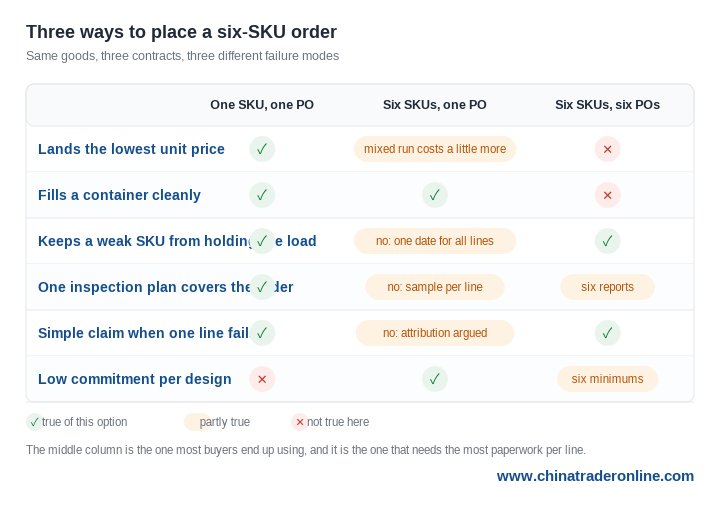
Ask for the carton dimensions and the pieces per carton for every SKU, then multiply out. A 20-foot container holds roughly 28 to 33 cubic metres of usable space and a 40-foot roughly 58 to 67, depending on how the cartons stack and whether you need aisle space for a mixed load. Six SKUs almost never cube out perfectly, so plan for about 10 percent of the volume to be lost to the last carton of each line.
That calculation, not the MOQ, should decide your quantities. If the mix leaves 6 cubic metres empty, the cheapest move is usually to add volume to the SKU with the lowest unit price and the best sell-through, not to add a seventh design.
Inspect per line, not per shipment
An AQL sampling plan drawn on the whole shipment hides a bad SKU inside a good one. Draw the sample per line, with its own accept and reject numbers, and write in the report which line each defect belongs to. On a six-line order that is six small inspections, and it is the only way a claim survives the argument about whose units failed.
Then specify the functional test per product type instead of a generic "function test". A light needs a burn test long enough to catch a bad driver; a radio needs tuning across the band; anything with a rechargeable cell needs a charge and discharge cycle. Ten units per line, tested in front of the inspector, catches more than a hundred units looked at.
Keep the paperwork as mixed as the load
The packing list is where a mixed container succeeds or fails at destination. Require carton marks carrying the SKU code, quantity, and a line number that matches the PO, and require the cartons of one SKU to be grouped rather than scattered through the load. If the boxes are unloaded in the order they come out, grouping is what lets a warehouse receive six lines in one pass.
Add one instruction that costs nothing: a photo of the finished load, taken before the doors close, showing the carton marks and the stacking pattern. When a line is short or a carton is crushed, that photo ends the conversation in your favour.
Sourcing products from China?
Send your product list and target quantity for a quote and a digital proof.
Get a free quoteRelated products
Wholesale--Special Offer! Electronic Gadgets Hand-Crank Dynamo or Solar All-In-One Lantern RadioCTO56427
 Keyboard Electronic Gadgets black /silver Cool Design Rii Mini WirelessCTO56501
 Bluetooth Sun Glasses 2GB Mp3 Player Hi-Fi Stereo Headset Sunglasses BlackCTO63653
 Toilet Shape New Cord Phone Home Desk Telephone PinkCTO63792
 LED Keychains 2 in 1 Red Laser Pointer FlashlightCTO63828