Flashing Pin Bulk Order: 6 Plating Options and Wear Rates
On a flashing pin, the electronics usually outlive the finish. The LED and the coin cell either work or fail in the first minute, which is easy to catch. The plating fails slowly, over a season of handling, and it fails exactly where a buyer looks first: the raised edge, the lettering, the rim of the body. Choosing a finish is therefore a question about wear, not about colour.
What Wears on a Flashing Pin Before the LED Fails
A flashing pin is a stamped metal body with an LED circuit, a coin cell and a pin back. The plating sits on the stamped body, and the stamping is what makes the wear pattern predictable. Every stamped edge carries a burr and a thinned deposit, because electroplating throws less metal into a sharp edge than onto a flat face. Those edges are also where a finger rubs hardest.
Three mechanisms do the damage. Abrasion removes the top layer at the high points. Galvanic action between two different metals, usually at a scratch that exposes the base metal, lifts the surrounding deposit. And on any finish that relies on a lacquer to hold its colour, the lacquer goes first, and the colour goes with it.
Six Plating Options, Sorted by How They Fail
Bright nickel. Hard, bright and cheap to run, which is why it is the default. It wears to a dull grey at the high points, then to base metal, and it puts nickel in direct skin contact — a compliance question, not an aesthetic one.
Nickel-free, usually copper-tin. The finish chosen when a skin contact requirement rules nickel out. Slightly warmer in tone than bright nickel, and softer, so the wear appears sooner as a polish rather than as a colour change.
Gold tone over a nickel layer. The colour is real but the thickness decides the life. A thin gold deposit wears through at the rim within a season of handling and exposes the nickel underneath, which reads as a colour change from gold to grey rather than as a scratch.
Antique brass. An electroplated brass tone, oxidised to darken the recesses, then lacquered. It hides scratches better than any bright finish because the surface is intentionally uneven. It also fails first at the lacquer, which is the part nobody quotes.
Chrome. Hard and bright, and brittle. It resists abrasion on flat faces and flakes at a sharp stamped edge where the deposit is thin.
Black nickel or a dyed finish. The most visible wear of the six, because a dark surface showing a light base metal reads as a defect at arm length. It is also the finish most sensitive to dye lot variation between baths.
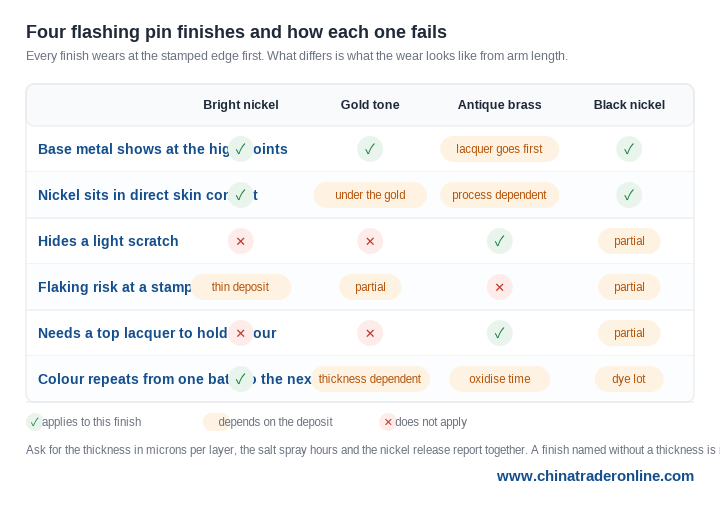
Wear Rate Is a Test Result, Not a Description
No supplier can tell you a wear rate from a photograph, and a claim such as long lasting is not a specification. Two tests convert the claim into something checkable. The first is a neutral salt spray run on a plated blank, with the hours recorded and the report attached. The second is an abrasion test on the finished part: rub the same spot with the same cloth for the same number of strokes across the candidate finishes, and compare where the base metal appears.
Neither test predicts a number of years, and neither should be asked to. What they do is rank the finishes against each other on the same day, with the same operator, which is the only comparison that survives a change of supplier. Ask for the salt spray hours in writing and for the abrasion result as a photo of the rubbed area, not as a word.
Why the Same Plating Name Gives Two Different Results
Plating is a bath, not a recipe. Two factories quoting bright nickel are quoting two different thicknesses, two different brightener systems and two different rinse practices. The name on the quotation is the same; the deposit is not. That is why a reorder from a second factory can look wrong even when the specification line is copied exactly.
The variables that move the result most are deposit thickness, the barrier layer under the top finish, and the condition of the base metal. A scratched or oily blank plates badly no matter what follows. Ask for the thickness in microns per layer, because a quotation that names only the top finish has not told you what the part will look like after handling.
Skin Contact: The One Requirement That Outranks Looks
A pin is worn against clothing and often against skin, and in the EU that puts it in the scope of the nickel release rules for items in prolonged contact with the skin. The test is a release test, not a content test, so a part can contain nickel and still pass if the release rate is low enough. The practical routes are a nickel-free finish, or a nickel layer sealed under a durable top coat.
Ask for the release test report with the sample, not after the order. A factory that has never been asked for one will not have it, and finding that out before the deposit is much cheaper than finding it out at customs. If the pin is a giveaway for a children-oriented campaign, the age grading question comes first and the plating question second.
What to Put in the Order
Five lines turn a plating discussion into a specification: the finish by layer with thickness in microns, the base metal, the salt spray hours with the report attached, the abrasion result as a photo, and the skin contact requirement with its test report. Add the battery type and the LED count: a three-LED pin with a coin cell has a different back plate, and the back plate is plated too.
Then keep one approved sample per finish, labelled with the bath date. When the next order arrives and the colour looks a shade off, the sample answers the question in a minute instead of a week of photographs.
If you are ordering flashing pins and want six finishes quoted with the thickness and the test reports stated per line, send the artwork, the pin size and the quantity, and we will return the comparison with the wear test on the rim included.
Sourcing products from China?
Send your product list and target quantity for a quote and a digital proof.
Get a free quote


