Mixed Container Sourcing: How 10 Categories Share One 40HQ
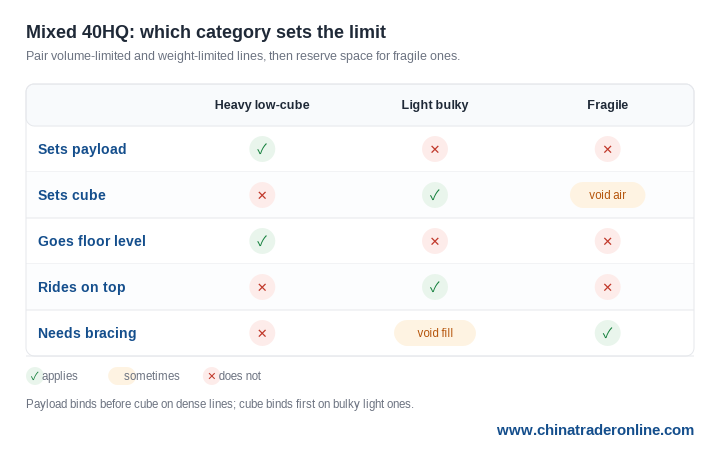
A mixed 40HQ is not a shopping basket. It is a fixed box with two ceilings — cubic metres and payload — and ten categories only share it well when their densities complement each other. Load ten light, bulky lines and the container sails half empty on weight; load ten dense lines and it hits the weight limit with hundreds of cubic metres unused. The planning work sits entirely in that gap.
The two ceilings, and which one binds
A 40-foot high cube measures about 12.03 m internal length, 2.35 m width and 2.39 m height, which gives roughly 67 to 68 cubic metres of usable space. Its payload is usually quoted between 26 and 28 tonnes depending on the chassis and the carrier, and road limits in the destination country may cut that further.
Compute the cube of each line before you talk about quantities: length × width × height in centimetres divided by one million gives cubic metres per carton; multiply by cartons and you have the line's volume. Compare that with the line's total weight. A category that fills a cubic metre with 40 kg is volume-limited, one that fills it with 400 kg is weight-limited, and the whole plan is a matter of pairing the two.
Build the floor first, then fill upward
The floor layer decides whether the container is safe. Put the heaviest, most uniform cartons down there — hardware, tool sets, ceramics in double-wall cartons — and check that they can carry the load above them without crushing. A carton rated for 15 kg stacked under four layers of 20 kg cartons will fail quietly in transit, and the damage appears at destination as a crushed top tier.
Then work upward in descending density. Light, bulky lines go on top where their volume is doing useful work filling the space over the heavy base. Fragile items go where nothing can be stacked on them, and that position has to be reserved before the quantities are fixed, not discovered at loading.

Harmonise cartons, or pay for the gaps
Ten suppliers means ten carton specifications, and mismatched cartons create void space that you pay for twice — once in freight and once in bracing material. The cheapest fix is to ask every supplier for cartons built on two or three common footprints, ideally multiples of a pallet module, with heights that stack to a round number.
Where a supplier cannot change its carton, plan those lines as the top tier or as gap fillers. The measure to watch is not average carton size but stacking efficiency: a layer that leaves a 15 cm strip along one side loses more space over a full container than a slightly larger carton that closes the pattern. Ask for a loading diagram with the pattern drawn, not a description of it.
Consolidation is the part that slips
Ten factories do not deliver on the same day. A mixed container usually consolidates at one warehouse, which means ten sets of cartons arriving over one or two weeks, each needing to be received, checked and staged. The plan has to name the cut-off: any line that misses it either delays the container or ships in the next one, and both outcomes cost more than the line was worth.
Build the schedule backwards from the vessel date, allow a staging window for the slowest line, and confirm in writing which lines are on the critical path. Where a line is chronically late, move it to a separate shipment rather than holding nine categories hostage to one.
Documentation that survives ten suppliers
A mixed load fails at customs or at receiving far more often than at loading. Every line needs its own HS code, its own description and its own quantity on the packing list, and the carton marks must match those lines exactly. Ten suppliers will produce ten mark formats unless you issue one yourself — a template with the consignee, the line number, the carton count and the SKU is enough.
Photograph each line as it is staged and again inside the container. When a shortfall appears three weeks later, that photo set settles the question of whether the carton was ever loaded, which is otherwise an argument you cannot win.
Verify the load before the doors close
Ask for three things at loading: the loading diagram with actual carton positions, photos of each tier, and the total gross weight from the weighbridge ticket. Then compare the weight with the payload limit and the volume with the booked cube. A container that closes easily can still be overloaded, and an overload discovered at the port is a rework, not a conversation.
Run the same arithmetic on the next order before you change suppliers. The electronic gadgets range is a good place to start, because its cartons are small and light enough to absorb the volume left over by heavier lines — which is exactly the role a filler category should play in a mixed container.
Sourcing products from China?
Send your product list and target quantity for a quote and a digital proof.
Get a free quote


