QC Checklist for Multi-category Orders
Multi-category orders fail at the carton, not at the product. A buyer inspects one SKU carefully, approves it, and then discovers that the second SKU is short by forty pieces, that two cartons carry the wrong barcode, and that the charger in the third SKU has a plug nobody checked. The checklist that catches those three things is shorter than most inspection forms and has nothing to do with product features.
Start from the carton, because that is where the order is counted
Before a single unit comes out of a box, verify the count at carton level. Cartons per SKU against the packing list, pieces per carton against the declaration, and gross weight per carton against the stated figure. Three numbers per SKU, and they take an hour for an order of ten SKUs. A carton that weighs 1.2 kilograms against a declared 2.4 has half the pieces in it, and no amount of product inspection downstream will find that.
Then read the carton marks. SKU code, colour code, quantity, carton number in sequence, and the shipping mark as agreed. Out-of-sequence carton numbers usually mean the factory packed from a partial run, and that is the moment to ask what is missing rather than at the port.
Sample per SKU, not per order
An order of ten SKUs is ten lots for inspection purposes, even when it ships on one purchase order. Sampling the order as a whole concentrates the sample in whichever SKU the inspector opened first and leaves the small lines with two or three pieces checked. Under ISO 2859-1 at general inspection level II, a lot of 1,200 to 3,200 pieces samples 125 pieces; at an AQL of 2.5 that allows seven majors and rejects at eight. A lot of 501 to 1,200 pieces samples 80, which allows five. Those numbers are worth carrying on the form, because they turn an argument about "a few defects" into a comparison against an agreed acceptance figure.
Write the lot boundary per SKU on the form before the inspection starts. An inspector who is told to "check the order" will improvise; one who is told that SKU A is 2,000 pieces and SKU B is 300 will sample both correctly and finish in the same day.
Four checks that apply to every category
Count the pieces in the sampled carton by hand, not by the label. Weigh the unit and compare against the approved sample, because a lighter unit is the fastest signal of a thinner material or a smaller battery. Measure the one dimension the customer will notice: the outer length of a bag, the diameter of a mug, the length of a cable. And switch the thing on, with the power source it will ship with, for long enough that a flat battery or a dead LED shows up.
Those four lines cost about two minutes per unit and catch the majority of what actually reaches a customer. Everything else on the form is category-specific, and category-specific lines are where inspectors run out of time.

Category lines: what changes when the product changes
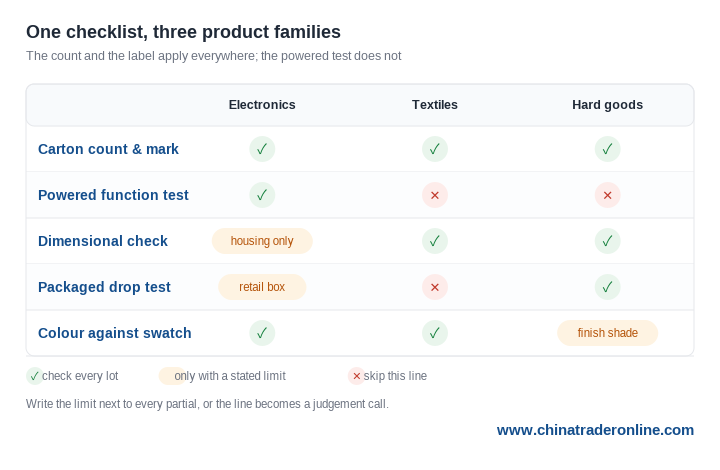
Electronics need a powered function test on every sampled unit, a charge or discharge cycle on a subset, and a battery marking check against the transport document the cells were shipped under. They also need the plug or the input voltage verified against the destination market, which is a five-second check that gets skipped when the carton is already sealed.
Textiles need a measurement table with tolerances rather than a single size, and colour assessed against the approved swatch under a consistent light. Hard goods need a packaged drop from a stated height, on a corner and on an edge, plus a finish check at the point the customer touches first: the rim of a mug, the handle anchor of a bag, the edge of a tray.
Run the day in a fixed sequence
Count everything first, while the cartons are still sealed and the stack still matches the loading plan. Then open cartons in SKU order and inspect, keeping the sampled units in a marked area rather than putting them back. Photograph three things per SKU: the carton label with the count visible, the sample group laid out, and each defect next to a ruler. Put the photos in the report in the order the defects appear in the text, or the reader will spend ten minutes matching a photograph of a scratch to a line about a crack.
Finish with the packing check: inner box, polybag, manual, accessory bag, and the retail packaging if there is one. That last fifteen minutes is where the missing adapter, the wrong manual language and the absent warranty card are found, and those are the defects that generate the customer complaints that no AQL figure captures.
Write the report so it can be argued with later
A usable report has five parts: the lot definition per SKU, the sample size and acceptance figure, the defect list classified as critical, major or minor, the photographs, and the carton count signed by the person who counted. Critical is anything that injures or fails legally, major is anything a customer would return, minor is cosmetic. Agree those three definitions before the inspection, not after, because the difference between a major and a minor is usually the difference between a rework and a discount.
Keep the same form for every order and archive it with the shipment. When a claim appears three months later, the value of the document is not that it says the goods were good; it is that it records what was sampled, what was found, and who agreed the number. Browsing the electronic gadgets range with that form already open is a faster way to price an inspection than deciding the sample size after the goods are packed.
Sourcing products from China?
Send your product list and target quantity for a quote and a digital proof.
Get a free quoteRelated products
 Bluetooth Sun Glasses 2GB Mp3 Player Hi-Fi Stereo Headset Sunglasses BlackCTO63653
 Toilet Shape New Cord Phone Home Desk Telephone PinkCTO63792
 3 LED High Power Ceiling Light Down Recessed Lamp White 85~265V 3W CabinetCTO63821
LED Keychains 2 in 1 Red Laser Pointer FlashlightCTO63828
 SSC P7 LED 3-Mode 900 Lumen LED Drop-in Module Flashlight Torch Replacement Bulb(3.6-4.2V)CTO63852