USB Products Sourcing Guide: 7 Product Types and Their Tests
Seven USB product types share one connector and almost nothing else. A flash drive, a power bank, a hub, a charger, a cable, a novelty desk gadget and a card reader each fail in a different way, so a single "USB products, good quality" clause tells a factory nothing and you nothing when the carton arrives.
The useful split is by test rather than by name. Performance tests answer whether the thing does what the label says: capacity, speed, output current, voltage drop. Electrical safety files answer whether it can be plugged in without hazard, and they apply only to the types that touch mains power or contain a lithium cell. Mechanical tests answer whether it survives use: insertion cycles, cable strain, port retention. A product shipped without the right one of the three generates the returns.
Here is how those tests land on each of the seven types, with the numbers to write into the order.
Flash drives and memory: capacity is a claim to be verified
Fake capacity is a firmware trick, not a hardware shortage: the controller reports 32 GB and then overwrites the same cells once the real capacity is passed, so the drive appears to work until the file list collapses. Verify by filling the whole declared span with files and reading them back under checksum.
Speed separates grades that look identical in a photo: a USB 2.0 drive with a competent controller sustains roughly 20 to 35 MB/s read, and a USB 3.0 drive in the same shell can reach several times that. Ask for sequential figures and for 4 KB random writes, because the random number decides whether the drive is usable for a file that has to open on someone else's laptop.
Also ask what the memory is. Drives built on recycled or downgraded NAND pass a capacity test on arrival and lose files months later, a warranty problem you own rather than the factory.
Hubs and multi-function devices: the power budget is the spec
A bus-powered hub draws from the host port, which supplies a finite current — nominally 500 mA on a USB 2.0 port. A four-port hub that advertises 500 mA on every port is either lying or relying on an external adapter that may not be in the box. Write the power arrangement into the order: bus-powered with a stated total budget, or self-powered with the adapter included and its rating named.
Test by loading it: plug in the heaviest combination the buyer intends — external drive, phone, card reader — and watch for a device dropping off the bus when the last item is added. Then check the regulator after twenty minutes; warm is normal, too hot to hold means it will fail in a closed laptop bag.

Cables: gauge and voltage drop, measured not assumed
A cable is two power conductors and two data pairs, and the power conductors decide whether a phone charges at 2 A or crawls. A 1 m cable built on 28 AWG power conductors adds roughly 0.4 ohm across the pair, which at 2 A costs close to 0.8 V; the same cable on 24 AWG loses about a third of that. At the phone that difference is the gap between fast charging and a charge icon that never moves.
Measure it rather than argue it: put a USB power meter between the source and the load, draw a known 2 A, and read the voltage at the load end. Anything much below 4.8 V at the device means the cable is the bottleneck, not the charger. Then test the connector: a standard USB-A plug is rated for 1,500 insertion cycles, and the failure to look for is retention — a plug that no longer clicks into place will drop a connection mid-transfer.
Bend the cable at the strain relief, not in the middle, twenty times and re-read the voltage. That junction is where cheap cables break.
Chargers and power banks: the two types that need a file
These are the only two in the seven that carry a safety file as a matter of course. A mains charger needs its safety test to the current edition of the applicable standard — IEC 62368-1 replaced the older 60950-1 for information technology equipment — plus the plug and marking requirements of the destination market. A power bank needs UN38.3 for transport plus a cell safety report, and its capacity should be quoted at the 5 V output rather than at the cell voltage.
For the charger, add two performance numbers: output voltage under load and ripple. A charger that reads 5.1 V open-circuit and 4.6 V at 2 A is a charger that will make every device on the order look slow. For the power bank, measure the actual delivered capacity with a USB meter under a 1 A load; the number should be close to the rated output, not the cell figure printed on the case.
Novelty USB devices: current draw, heat and the cable exit
Fans, warmers, aquariums and massage gadgets are simple circuits, and they fail mechanically rather than electrically. Three checks cover most of it: current draw against the port budget, surface temperature after twenty minutes, and strain at the point where the cable leaves the housing. That last one is the usual failure — a moulded exit with no internal strain relief will fracture the conductor inside the insulation while the outside still looks intact.
Test ten pieces from the pilot run and flex the cable exit thirty times on each. If the device cuts out during the flex, the assembly is the problem, not the motor.
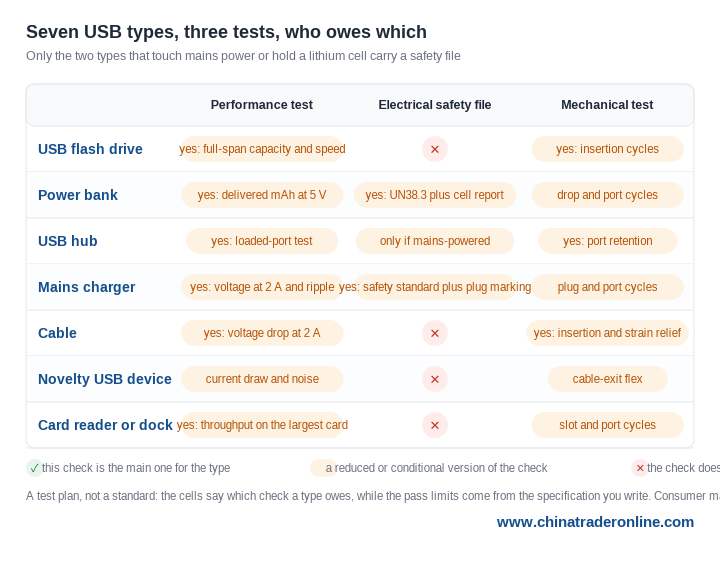
One sheet, seven rows
Put the seven types down the left of a page and the three test columns across the top, then fill in only the cells that apply. Flash drive: full-span write and read-back, sequential and 4 KB speeds, insertion cycles. Power bank: UN38.3 with test summary, delivered capacity at 5 V and 1 A. Hub: stated power budget, loaded-port test, regulator temperature. Charger: safety file, voltage at 2 A, ripple. Cable: 2 A voltage drop, plug retention, strain-relief flex. Novelty device: current draw, surface temperature, cable-exit flex on ten pieces. Reader or dock: throughput on the largest card you expect, and driver behaviour on a clean machine.
Seven rows is a short document that tells the factory which number will be measured. The USB products category shows how far the range runs, from memory sticks to mains-powered hubs.
Sourcing products from China?
Send your product list and target quantity for a quote and a digital proof.
Get a free quote


