How to Vet a New Supplier in 48 Hours
Two days is enough to decide whether a new supplier is worth a trial order, and it is not enough to decide whether they are good. The 48 hours are spent on three questions in a fixed order: does the company exist, can it make this product, and will it put a defect in writing. Skipping the order is how buyers end up with a paid deposit and a factory that turns out to be a trading office with a borrowed showroom.
The 48-Hour Order of Checks
Run the checks in this sequence because each one can end the process. Hour one is paperwork: licence, scope, bank account, and the name on the quotation. Day one is a live video walk with no advance warning of which line you want to see. Day one afternoon is the trade record and, if time zones allow, one reference call. Day two is the sample request with a defect log attached, and a written statement of what happens when the sample fails.
A supplier who resists any of these four steps is giving an answer. The resistance itself is data, and it costs nothing to notice.
Hour One: The Licence, the Scope and the Bank Account
The business licence carries an 18-character unified social credit code, the registered address, the establishment date and the business scope. Read the scope rather than the company name: a scope that lists trading and import-export but not manufacturing tells you the entity is a trader, which is a legitimate business but a different one from the factory in the photos.
Registered capital is not paid-in capital, so treat a large number as a claim rather than as evidence. The harder check is the bank account. The account name on the proforma invoice has to match the licence entity exactly; a payment instruction that names a third party, a personal account or an unrelated trading company is the single most reliable warning sign in the whole process, and it appears before any money moves.
Day One: The Video Walk That Cannot Be Staged
Ask for a live video call, not a recording, and ask for it at a time the factory chooses so nobody has an excuse. Then direct the camera yourself. Start at the door plate with the company name, pan to the loading bay, walk to the machine that makes your product, and ask the operator to run one cycle. A staged walk stalls at exactly these points: the door plate is missing, the loading bay is empty, the machine is not running, or the operator is not there.
Three details are worth the camera time. The machine nameplate, because a plant that owns the right machine is a plant that can hold tolerance. The work in progress, because a factory with orders has parts on the floor and a factory without them has a clean one. And the clock, because the timestamp on the video is what ties the walk to the day.
Day One, Part Two: Trade Record and One Reference Call
Trade record shows experience rather than capacity, and it is easy to over-read. What it does answer is whether the supplier has shipped this product category before, and to which markets, which matters for certification and labelling. Ask for the destination countries rather than the customer names; a supplier who will not name customers is normal, a supplier who cannot name a single destination country is not.
One reference call is worth more than five references on a page, if you reach someone who actually bought. Ask what went wrong, not what went right: a reference who describes a late shipment and how it was handled is more useful than one who says everything was fine. If the time zone makes the call impossible inside 48 hours, put it in the calendar for the following week and do not pretend it happened.
Day Two: The Sample and the Defect Log
A sample is the only evidence that survives the two days. Request it with a defect log attached: a one-page sheet with the checks you will run, the acceptance limits, and the columns for measured values. A supplier who returns the log filled in has shown you their inspection culture; a supplier who returns the sample alone has shown you the sample only.

Pair the sample with a written answer to one question: when a defect is found at inspection, who pays for the rework and how is the date protected. The answer reveals whether the quality clause is a document or a habit.
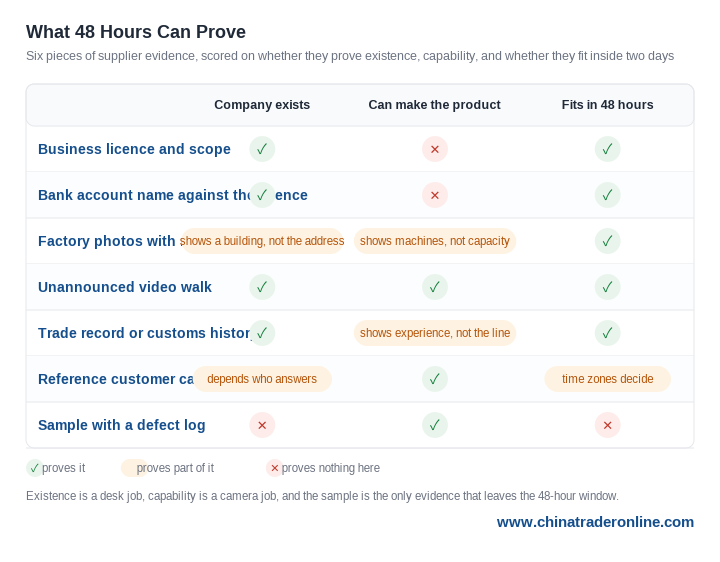
What 48 Hours Cannot Prove
Two days will not tell you whether a supplier holds a delivery date under pressure, whether their subcontractor changes without notice, or whether the second order matches the first. Those answers come from a trial order with a small quantity and a hard date, and the 48 hours exist to make sure the trial goes to a real factory rather than to a rented showroom.
Write the outcome of the two days into one page: what was verified, what was claimed but not verified, and what the trial order has to prove. That page is what makes the next 48 hours faster.
Send us the product and the market, and we will send back the licence, the factory walk and a quoted sample with a defect log, so the two days start with evidence rather than introductions.
Sourcing products from China?
Send your product list and target quantity for a quote and a digital proof.
Get a free quoteRelated products
 Coin Bank With Key Chain As Promotional Gifts GiveawaysCTO17866
 Coin Bank with Cartoon Football Design, Suitable for FIFA World Cup 2010 Promotional GiftsCTO29435
 Eco-friendly Cute Paper Clips with Novel Design, Made of Soft PVC, Suitable for Promotional GiftsCTO57367
Desktop Calendar in Classic Design, Suitable for Office and Promotional GiftsCTO58099
 Lead-free Cocktail Glass for Ice-cream, Can be used as Promotional GiftsCTO59162